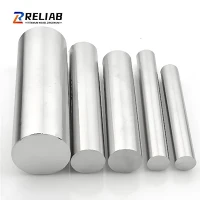
As a supplier of CP (Commercially Pure) Titanium Bars, I am often asked about the various grinding methods for these bars. Grinding is a crucial process in the manufacturing and finishing of CP Titanium Bars, as it can significantly affect the bar's surface quality, dimensional accuracy, and overall performance. In this blog post, I will delve into the different grinding methods used for CP Titanium Bars, their advantages, and considerations.
1. Surface Grinding
Surface grinding is one of the most common methods used for CP Titanium Bars. It involves using a grinding wheel to remove material from the surface of the bar to achieve a smooth and flat finish. This method is suitable for achieving tight tolerances and high surface quality.


Process
In surface grinding, the CP Titanium Bar is placed on a magnetic chuck or a fixture to hold it in place. The grinding wheel rotates at a high speed and moves across the surface of the bar, removing a thin layer of material with each pass. The depth of cut is carefully controlled to ensure that the desired surface finish and dimensional accuracy are achieved.
Advantages
- High Surface Quality: Surface grinding can produce a very smooth surface finish, which is essential for applications where a low friction coefficient or a high level of corrosion resistance is required.
- Tight Tolerances: This method allows for precise control of the bar's dimensions, making it suitable for applications that require high precision.
- Versatility: Surface grinding can be used on a variety of CP Titanium Bar sizes and shapes, making it a versatile grinding method.
Considerations
- Heat Generation: Grinding generates a significant amount of heat, which can cause the titanium bar to deform or develop surface cracks. To prevent this, a coolant is often used to dissipate the heat and lubricate the grinding wheel.
- Wheel Selection: The choice of grinding wheel is crucial for achieving the desired surface finish and material removal rate. Different types of grinding wheels are available, each with its own characteristics and suitability for specific applications.
2. Centerless Grinding
Centerless grinding is another popular method for grinding CP Titanium Bars. This method is used to grind the outer diameter of the bar without the need for a center hole or a chuck.
Process
In centerless grinding, the CP Titanium Bar is supported between a grinding wheel, a regulating wheel, and a work rest blade. The grinding wheel rotates at a high speed and removes material from the outer surface of the bar, while the regulating wheel controls the bar's rotation and feed rate. The work rest blade supports the bar and ensures that it remains in a stable position during the grinding process.
Advantages
- High Productivity: Centerless grinding is a highly efficient method that can produce a large number of CP Titanium Bars in a short period of time.
- Good Dimensional Accuracy: This method can achieve high levels of dimensional accuracy, making it suitable for applications that require precise outer diameters.
- Smooth Surface Finish: Centerless grinding can produce a smooth surface finish on the outer diameter of the bar, which is beneficial for applications where a low friction coefficient is required.
Considerations
- Initial Setup: Centerless grinding requires a more complex setup compared to surface grinding, as the grinding and regulating wheels need to be properly aligned and adjusted.
- Limited Bar Length: Centerless grinding is typically limited to grinding bars of a certain length, as longer bars may be difficult to support and control during the grinding process.
3. Cylindrical Grinding
Cylindrical grinding is a method used to grind the outer diameter of CP Titanium Bars to a specific size and shape. This method is similar to centerless grinding, but it uses a chuck to hold the bar in place.
Process
In cylindrical grinding, the CP Titanium Bar is held in a chuck and rotated while a grinding wheel moves along the length of the bar, removing material from the outer surface. The grinding wheel can be adjusted to achieve the desired diameter and surface finish.
Advantages
- Precise Dimensional Control: Cylindrical grinding allows for precise control of the bar's outer diameter, making it suitable for applications that require high precision.
- Suitable for Long Bars: This method can be used to grind long CP Titanium Bars, as the chuck provides a stable support for the bar during the grinding process.
- Versatility: Cylindrical grinding can be used to grind bars of different diameters and lengths, making it a versatile grinding method.
Considerations
- Chucking Issues: Holding the bar in a chuck can sometimes cause distortion or damage to the bar, especially if the chuck is not properly aligned or tightened.
- Surface Finish: Achieving a smooth surface finish can be more challenging with cylindrical grinding compared to other methods, as the grinding wheel may leave marks or scratches on the bar's surface.
4. Internal Grinding
Internal grinding is used to grind the inner diameter of CP Titanium Bars. This method is often used for applications where a precise internal diameter is required, such as in the manufacturing of pipes or tubes.
Process
In internal grinding, a grinding wheel is inserted into the inner diameter of the bar and rotated at a high speed. The grinding wheel moves along the length of the bar, removing material from the inner surface to achieve the desired diameter and surface finish.
Advantages
- Precise Internal Diameter: Internal grinding can achieve high levels of precision in the inner diameter of the bar, making it suitable for applications that require tight tolerances.
- Smooth Surface Finish: This method can produce a smooth surface finish on the inner diameter of the bar, which is beneficial for applications where a low friction coefficient is required.
- Versatility: Internal grinding can be used on a variety of CP Titanium Bar sizes and shapes, making it a versatile grinding method.
Considerations
- Limited Access: Grinding the inner diameter of a bar can be challenging, as the grinding wheel needs to be inserted into the bar's interior. This can limit the size and shape of the bars that can be ground using this method.
- Heat Generation: Similar to other grinding methods, internal grinding generates a significant amount of heat, which can cause the bar to deform or develop surface cracks. A coolant is often used to dissipate the heat and lubricate the grinding wheel.
Conclusion
In conclusion, there are several grinding methods available for CP Titanium Bars, each with its own advantages and considerations. Surface grinding is suitable for achieving a smooth and flat finish, centerless grinding is efficient for high-volume production, cylindrical grinding allows for precise dimensional control, and internal grinding is used for grinding the inner diameter of the bar. As a supplier of CP Titanium Bars, we have the expertise and equipment to perform these grinding methods to meet the specific requirements of our customers.
If you are interested in purchasing CP Titanium Bars or have any questions about the grinding methods, please feel free to [contact us for procurement and negotiation]. We look forward to working with you to provide high-quality CP Titanium Bars that meet your needs.
References
- Smith, J. (2018). Titanium Alloys: Properties, Processing, and Applications. CRC Press.
- Jones, A. (2019). Grinding Technology: Theory and Applications of Machining with Abrasives. Springer.
- Brown, C. (2020). Manufacturing Processes for Engineering Materials. Wiley.