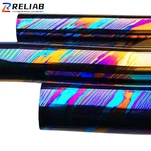
The discoloration of titanium is a magic trick of light and film.
01. Titanium oxide film:
When titanium is first exposed to air, an oxide film quickly forms on its surface. This film is mainly titanium dioxide (TiO₂), only a few nanometers thick, invisible to the naked eye, but it is already subtly changing the unique color of titanium.
This film has several characteristics: dense: effectively preventing further oxidation; transparent: unlike rust, it doesn't obscure the metallic luster; high refractive index: highly sensitive to the reflection and refraction of light.
In other words, titanium naturally has an "optical filter," but it's so thin that the color hasn't yet shown up.
02. The real color change of titanium is achieved through a technique called "anodization."
The process is simple: the titanium product to be colored is used as the anode, and another metal (such as aluminum) is placed in a specific electrolyte (such as sodium hydroxide) as the cathode. An electric current is applied, and as the voltage increases, the oxide film on the titanium surface begins to grow. The thicker the film, the more pronounced the color. This isn't dyeing; it's the interference effect of light. When light enters the film, some is reflected at the surface, and some penetrates to the bottom and is reflected again. When the two beams of light overlap, some wavelengths are amplified, while others are canceled out, ultimately resulting in the color seen by the human eye.
key points: film thickness determines color, and voltage determines film thickness.
03. Color Adjustment
The color variations of titanium are not random, but follow a pattern.
As the oxide film thickness increases, the surface color of titanium exhibits the following progression:
0-10V: No obvious color or silver-gray (extremely thin oxide film, almost no interference effect).
10-15V: Light yellow or golden yellow.
15-20V: Golden yellow deepens, with a hint of brown.
20-30V: Purple or dark purple.
30-40V: Dark blue.
40-50V: Light blue or sky blue.
50-60V: Green or yellowish-green.
60-70V: Light green.
70-80V: Pink or rose red.
80-90V: Purplish-red.
90-100V: Dark green or olive green.
Above 100V: The color may begin to cycle (e.g., yellow or purple reappears), but the oxide film is usually thicker, and the color may be uneven or become dull.
For those with hands-on skills, you can try it yourself using the "palette" shown above.
For every 1 volt increase in voltage, the film thickness increases by approximately 2 nanometers. The thickness range corresponding to each color also varies.
It's like a palette; each nanometer represents a precise color application by the artist.
However, a thicker film isn't always better. Excessive thickness can lead to decreased color saturation, even "ablation," film instability, and uneven color.
04. Applications
Titanium's color-changing properties are not only aesthetically pleasing but also practical.
Titanium cups, titanium chopsticks, titanium necklaces: rich colors, colorfast.
Titanium sculptures, titanium ornaments: exhibit a metallic rainbow after anodizing, with a strong visual impact.
Titanium eyeglass frames: lightweight, hypoallergenic, and long-lasting color.
Titanium watch cases, titanium keychains: both corrosion-resistant and highly recognizable.
Titanium implants: improved biocompatibility after anodizing.
However, the medical industry has extremely high requirements for color stability, often preferring to leave the film uncolored to ensure its purity.
Therefore, the color of titanium is not applied, but "grown." It doesn't rely on pigments, but on film thickness and light interference. It doesn't rely on art, but on the precise combination of voltage, time, and electrolyte.
This is a scientific beauty, an industrial romance.


Baoji Reliab Metal Materials Co.,Ltd
Mobile: 0086 13092900605
Sales Department 1: WhatsApp +8613092900605 (Mr.Gary)
Sales Department 2: +8613092913521(Ms. Sophia)
Address: No.35 Baoti Rd, Weibin District, Baoji, China