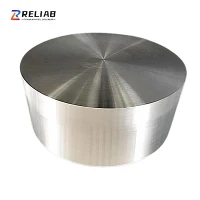
As a reliable supplier of Titanium Alloy Round Bars, I often receive inquiries about how to straighten these bars. Titanium alloy round bars are widely used in various industries due to their excellent properties such as high strength, low density, and good corrosion resistance. However, during the manufacturing, transportation, or storage process, these bars may become bent or deformed. Straightening them is crucial to ensure their proper use in different applications. In this blog, I will share some common methods of straightening titanium alloy round bars.
Understanding Titanium Alloy Properties
Before delving into the straightening methods, it's essential to understand the unique properties of titanium alloys. Titanium alloys have a relatively low modulus of elasticity compared to some other metals, which means they can withstand significant elastic deformation before reaching the plastic deformation stage. Additionally, titanium alloys have a high strength - to - weight ratio, but they are also sensitive to heat and strain rates. These properties influence the choice of straightening methods.
Cold Straightening
Cold straightening is a common method for straightening titanium alloy round bars, especially when the deformation is relatively small. This method involves applying external forces to the bent bar at room temperature to reshape it.
Manual Cold Straightening
For small - scale operations or when dealing with bars of relatively small diameters, manual cold straightening can be employed. Workers use simple tools such as hammers and anvils. They place the bent bar on a flat and hard surface, and then carefully strike the convex side of the bend with a hammer. This process requires a high level of skill and experience because excessive force can cause cracking or other damage to the titanium alloy.
Mechanical Cold Straightening
Mechanical cold straightening is more suitable for larger - scale production. Machines like presses and rollers are used. In a press, the bent bar is placed between two platens, and the press applies a controlled force to straighten the bar. Rollers, on the other hand, pass the bar through a series of adjustable rollers. The rollers gradually adjust the shape of the bar as it moves through them. This method provides more consistent results and is more efficient than manual cold straightening.
However, cold straightening has its limitations. Titanium alloys are prone to work - hardening during cold deformation. Work - hardening can increase the strength of the material in the straightened area but also reduce its ductility, which may lead to cracking during subsequent processing or use. Therefore, cold straightening is usually limited to cases where the degree of deformation is small and the requirements for the ductility of the final product are not extremely high.
Hot Straightening
When the deformation of the titanium alloy round bar is large or when maintaining the ductility of the material is crucial, hot straightening is a better option. Hot straightening involves heating the bar to a specific temperature range before applying the straightening force.
Heating Process
The heating temperature for hot straightening titanium alloy round bars is carefully controlled. Different titanium alloys have different optimal heating temperatures. Generally, the heating temperature is in the range of 600 - 900°C. Induction heating or furnace heating can be used. Induction heating is a fast and efficient method that can quickly heat the bar to the desired temperature. Furnace heating, on the other hand, provides more uniform heating, which is beneficial for large - diameter bars or when a high - quality straightening result is required.
Straightening at High Temperature
Once the bar reaches the appropriate temperature, it is transferred to the straightening equipment. Similar to cold straightening, presses or rollers can be used. At high temperatures, the titanium alloy becomes more malleable, and the risk of cracking is significantly reduced. After straightening, the bar needs to be cooled slowly to prevent thermal stress and ensure the stability of its mechanical properties.
Hot straightening not only can handle larger deformations but also helps to relieve the internal stress generated during the deformation process. It is an ideal method for applications where high - quality and high - precision straight bars are required, such as in the aerospace industry. For example, the Titanium AMS 6242 Bar for Aerospace often needs to be straightened to meet the strict dimensional and performance requirements of aerospace components.
Heat Treatment after Straightening
Regardless of whether cold or hot straightening is used, heat treatment after straightening is often necessary to optimize the mechanical properties of the titanium alloy round bar.
Annealing
Annealing is a common heat - treatment process. It involves heating the bar to a specific temperature and holding it for a certain period, followed by slow cooling. Annealing can relieve the internal stress generated during straightening, reduce work - hardening (in the case of cold straightening), and restore the ductility of the titanium alloy. The annealing temperature and time depend on the specific composition of the titanium alloy.
Solution Treatment and Aging
For some high - strength titanium alloys, solution treatment and aging are also used. Solution treatment involves heating the bar to a high temperature to dissolve all the alloying elements into the matrix, followed by rapid cooling. Aging is then carried out at a lower temperature to precipitate fine - grained strengthening phases, which can improve the strength and hardness of the alloy.
Quality Control
After straightening and heat treatment, strict quality control is essential to ensure that the titanium alloy round bars meet the required standards.
Dimensional Inspection
Dimensional inspection is the most basic form of quality control. Tools such as calipers, micrometers, and straightedge gauges are used to measure the diameter, length, and straightness of the bar. The straightness is usually measured by placing the bar on a flat surface and using a straightedge to check for any deviations.
Non - Destructive Testing
Non - destructive testing methods such as ultrasonic testing, magnetic particle testing, and eddy - current testing can be used to detect internal and surface defects in the straightened bar. These methods can identify cracks, inclusions, and other flaws that may affect the performance of the bar.
Mechanical Property Testing
Mechanical property testing, including tensile testing, hardness testing, and impact testing, is also carried out. These tests help to ensure that the straightened bar has the required strength, ductility, and toughness.
Conclusion
Straightening titanium alloy round bars is a complex process that requires a good understanding of the properties of titanium alloys and the appropriate selection of straightening methods. Cold straightening is suitable for small - scale and small - deformation cases, while hot straightening is more appropriate for large - scale and large - deformation applications. Heat treatment after straightening and strict quality control are crucial to ensure the performance and quality of the final product.


As a Titanium Alloy Round Bars supplier, we offer a wide range of products, including Ti - 6242 Titanium Bars and Grade 23 Medical Titanium Bars. Our products are manufactured with high - quality standards and can be customized according to your specific requirements. If you are interested in our products or have any questions about straightening titanium alloy round bars, please feel free to contact us for procurement and further discussion.
References
- "Titanium: A Technical Guide", Second Edition, ASM International.
- "Metal Forming: Processes and Applications", Kalpakjian and Schmid.
- "Materials Science and Engineering: An Introduction", William D. Callister, Jr. and David G. Rethwisch.