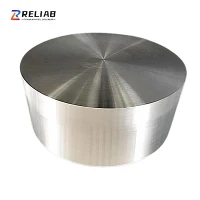
As a dedicated supplier of Titanium Alloy Round Bars, I've witnessed firsthand the transformative power of alloying elements on the properties of these remarkable materials. Titanium alloys are celebrated for their exceptional strength-to-weight ratio, corrosion resistance, and biocompatibility, making them indispensable in a wide range of industries, from aerospace and automotive to medical and marine. In this blog post, I'll delve into the fascinating world of titanium alloy round bars and explore how different alloying elements can enhance their performance and versatility.
Understanding Titanium Alloys
Titanium is a lightweight, high-strength metal with excellent corrosion resistance. However, in its pure form, titanium has limited mechanical properties and is relatively soft. To overcome these limitations, titanium is often alloyed with other elements to improve its strength, hardness, ductility, and other desirable properties. The addition of alloying elements can also enhance the alloy's resistance to specific environments, such as high temperatures, corrosive chemicals, or extreme pressures.
Common Alloying Elements in Titanium Alloys
There are several common alloying elements used in titanium alloys, each with its own unique properties and effects on the alloy's performance. Here are some of the most important alloying elements and their contributions to the properties of titanium alloy round bars:
Aluminum (Al)
Aluminum is one of the most widely used alloying elements in titanium alloys. It increases the strength and hardness of the alloy while reducing its density, making it an ideal choice for applications where weight savings are critical. Aluminum also improves the alloy's oxidation resistance and can enhance its creep resistance at elevated temperatures.
Vanadium (V)
Vanadium is another important alloying element in titanium alloys. It improves the strength and ductility of the alloy, making it more resistant to cracking and deformation. Vanadium also enhances the alloy's hardenability, allowing it to be heat-treated to achieve specific mechanical properties.
Molybdenum (Mo)
Molybdenum is often added to titanium alloys to improve their strength and corrosion resistance. It forms a stable oxide layer on the surface of the alloy, which protects it from oxidation and corrosion in harsh environments. Molybdenum also enhances the alloy's creep resistance at high temperatures, making it suitable for applications in the aerospace and power generation industries.
Iron (Fe)
Iron is a common impurity in titanium alloys, but it can also be intentionally added in small amounts to improve the alloy's strength and hardness. Iron can also enhance the alloy's machinability, making it easier to fabricate into complex shapes.
Oxygen (O)
Oxygen is a interstitial element in titanium alloys, and its presence can have a significant impact on the alloy's properties. In small amounts, oxygen can improve the strength and hardness of the alloy, but excessive oxygen can reduce its ductility and toughness. Therefore, the oxygen content in titanium alloys must be carefully controlled to achieve the desired balance of properties.
Effects of Alloying Elements on the Properties of Titanium Alloy Round Bars
The addition of alloying elements can have a profound effect on the properties of titanium alloy round bars. Here are some of the key properties that can be influenced by alloying elements:
Strength and Hardness
Alloying elements such as aluminum, vanadium, and molybdenum can significantly increase the strength and hardness of titanium alloy round bars. These elements form solid solutions with titanium, which strengthen the alloy by impeding the movement of dislocations. The addition of alloying elements can also enhance the alloy's hardenability, allowing it to be heat-treated to achieve even higher levels of strength and hardness.
Ductility and Toughness
While alloying elements can improve the strength and hardness of titanium alloy round bars, they can also reduce their ductility and toughness. This is because the presence of alloying elements can increase the alloy's brittleness and make it more prone to cracking and fracture. However, by carefully controlling the composition and processing of the alloy, it is possible to achieve a balance between strength and ductility, ensuring that the alloy has the required toughness for its intended application.
Corrosion Resistance
Titanium alloys are known for their excellent corrosion resistance, but the addition of certain alloying elements can further enhance this property. For example, the addition of molybdenum and chromium can improve the alloy's resistance to pitting and crevice corrosion in chloride-containing environments. The addition of aluminum can also enhance the alloy's oxidation resistance, making it more suitable for applications in high-temperature environments.
Heat Resistance
Alloying elements can also improve the heat resistance of titanium alloy round bars. Elements such as aluminum, vanadium, and molybdenum can increase the alloy's melting point and improve its creep resistance at elevated temperatures. This makes titanium alloys suitable for applications in the aerospace, automotive, and power generation industries, where high-temperature performance is critical.
Applications of Titanium Alloy Round Bars
The unique properties of titanium alloy round bars make them suitable for a wide range of applications across various industries. Here are some of the most common applications of titanium alloy round bars:
Aerospace Industry
Titanium alloy round bars are widely used in the aerospace industry due to their high strength-to-weight ratio, corrosion resistance, and heat resistance. They are used in the manufacture of aircraft components such as landing gear, engine parts, and structural frames. Titanium alloys are also used in the aerospace industry for their excellent fatigue resistance, which is essential for ensuring the safety and reliability of aircraft components.
Medical Industry
Titanium alloy round bars are also used in the medical industry due to their biocompatibility and corrosion resistance. They are used in the manufacture of medical implants such as hip and knee replacements, dental implants, and spinal implants. Titanium alloys are also used in the medical industry for their excellent mechanical properties, which allow them to withstand the stresses and strains of the human body.


Automotive Industry
Titanium alloy round bars are increasingly being used in the automotive industry due to their high strength-to-weight ratio and corrosion resistance. They are used in the manufacture of automotive components such as engine valves, connecting rods, and suspension components. Titanium alloys are also used in the automotive industry for their excellent heat resistance, which allows them to withstand the high temperatures generated by the engine.
Marine Industry
Titanium alloy round bars are used in the marine industry due to their excellent corrosion resistance in seawater. They are used in the manufacture of marine components such as propeller shafts, rudders, and hulls. Titanium alloys are also used in the marine industry for their high strength-to-weight ratio, which allows them to reduce the weight of the vessel and improve its fuel efficiency.
Conclusion
In conclusion, alloying elements play a crucial role in determining the properties and performance of titanium alloy round bars. By carefully selecting and controlling the composition of the alloy, it is possible to achieve a wide range of properties, including high strength, hardness, ductility, corrosion resistance, and heat resistance. These properties make titanium alloy round bars suitable for a wide range of applications across various industries, from aerospace and automotive to medical and marine.
If you're interested in learning more about our Titanium Alloy Round Bars, or if you have any specific requirements for your application, please don't hesitate to contact us for more information. Our team of experts is always ready to assist you in finding the right titanium alloy round bars for your needs.
References
- Boyer, R. R., Welsch, G., & Collings, E. W. (1994). Materials Properties Handbook: Titanium Alloys. ASM International.
- Donachie, M. J., & Donachie, S. J. (2002). Titanium: A Technical Guide. ASM International.
- Williams, J. C., & Starke, E. A. (2003). Progress in structural materials for aerospace systems. Acta Materialia, 51(19), 5775-5799.