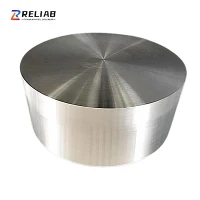
As a supplier of Titanium Alloy Round Bars, I am often asked about the elongation rate of these products. The elongation rate is a crucial mechanical property that reflects the ability of a material to deform plastically before breaking. In this blog, I will delve into what the elongation rate of titanium alloy round bars is, its significance, and how it varies among different types of titanium alloys.
Understanding the Elongation Rate
The elongation rate, also known as elongation at break, is defined as the percentage increase in the length of a specimen after it has been pulled to failure in a tensile test. It is a measure of the ductility of a material. A higher elongation rate indicates that the material can undergo more plastic deformation before fracturing, which is generally desirable in many applications.
When we talk about titanium alloy round bars, the elongation rate is determined by subjecting a standard test specimen to a uniaxial tensile force until it breaks. The initial and final lengths of the specimen are measured, and the elongation rate is calculated using the following formula:
[
\text{Elongation Rate} (%) = \frac{L_f - L_0}{L_0} \times 100
]
where (L_0) is the original length of the specimen and (L_f) is the length of the specimen after it has been pulled to failure.
Significance of the Elongation Rate in Titanium Alloy Round Bars
The elongation rate is an important property for titanium alloy round bars for several reasons. Firstly, it is an indicator of the material's formability. In applications where the titanium alloy round bars need to be bent, shaped, or machined, a higher elongation rate means that the material can be deformed without cracking or breaking. This is particularly important in industries such as aerospace, automotive, and medical, where complex shapes and precise dimensions are often required.
Secondly, the elongation rate is related to the material's ability to absorb energy. A material with a higher elongation rate can absorb more energy before fracturing, which is beneficial in applications where the bars may be subjected to impact or dynamic loading. For example, in the aerospace industry, titanium alloy round bars are used in components such as landing gear and engine parts, where they need to withstand high stresses and impacts.


Factors Affecting the Elongation Rate of Titanium Alloy Round Bars
The elongation rate of titanium alloy round bars can be influenced by several factors, including the alloy composition, heat treatment, and manufacturing process.
-
Alloy Composition: Different titanium alloys have different chemical compositions, which can significantly affect their mechanical properties, including the elongation rate. For example, Ti-6242 Titanium Bars are a high-strength titanium alloy with good creep resistance and high-temperature performance. The specific alloying elements in Ti-6242 can enhance its strength while still maintaining a reasonable elongation rate. You can learn more about Ti-6242 Titanium Bars.
-
Heat Treatment: Heat treatment is a crucial process for titanium alloys as it can alter their microstructure and mechanical properties. By subjecting the titanium alloy round bars to specific heat treatment cycles, the grain size, phase distribution, and precipitation of secondary phases can be controlled, which in turn affects the elongation rate. For example, annealing can increase the ductility of the material, resulting in a higher elongation rate.
-
Manufacturing Process: The manufacturing process used to produce the titanium alloy round bars can also impact the elongation rate. Processes such as forging, rolling, and extrusion can introduce different levels of internal stress and texture in the material, which can affect its mechanical properties. For instance, a well-controlled forging process can refine the grain structure of the titanium alloy, leading to improved ductility and a higher elongation rate.
Elongation Rates of Different Titanium Alloys
There are various types of titanium alloys, each with its own unique combination of properties, including the elongation rate. Here are some examples:
-
Gr5 ELI Medical Titanium Alloy Bar: This is a widely used titanium alloy in the medical industry due to its excellent biocompatibility, high strength, and good corrosion resistance. The Gr5 ELI alloy typically has an elongation rate of around 10 - 15%. This level of ductility allows for the fabrication of complex medical devices such as orthopedic implants and dental fixtures. You can find more information about Gr5 ELI Medical Titanium Alloy Bar.
-
Mokuti Titanium Rod: Mokuti titanium is a special type of titanium alloy known for its high strength and good ductility. The Mokuti Titanium Rod usually has an elongation rate of approximately 12 - 18%. This makes it suitable for applications where both strength and formability are required, such as in the production of high-performance sporting equipment and aerospace components. For more details, visit Mokuti Titanium Rod.
Importance of Accurate Elongation Rate Measurement
Accurate measurement of the elongation rate is essential for ensuring the quality and performance of titanium alloy round bars. In industries where safety and reliability are of utmost importance, such as aerospace and medical, precise knowledge of the elongation rate is crucial. Manufacturers need to conduct regular testing to ensure that the titanium alloy round bars meet the required specifications.
Moreover, accurate elongation rate data can also help in material selection and design. Engineers can use this information to determine the suitability of a particular titanium alloy for a specific application. For example, if a component requires high ductility, an alloy with a higher elongation rate would be preferred.
Conclusion
In conclusion, the elongation rate is a vital mechanical property of titanium alloy round bars. It provides valuable information about the material's formability, energy absorption capacity, and overall performance. As a supplier of Titanium Alloy Round Bars, we understand the importance of providing high-quality products with consistent and reliable elongation rates.
If you are in the market for titanium alloy round bars and have specific requirements regarding the elongation rate or other mechanical properties, we are here to help. We offer a wide range of titanium alloys, including Ti-6242, Gr5 ELI, and Mokuti, with various sizes and specifications. Our team of experts can assist you in selecting the most suitable titanium alloy for your application and ensure that you receive products that meet your exact needs.
We invite you to contact us for further discussion and to initiate the procurement process. Our commitment is to provide you with the best products and services, and we look forward to working with you to meet your titanium alloy round bar requirements.
References
- ASM Handbook Volume 2: Properties and Selection: Nonferrous Alloys and Special-Purpose Materials. ASM International.
- Titanium: A Technical Guide. John R. Davis (Editor). ASM International.