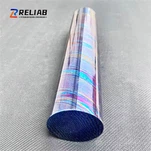
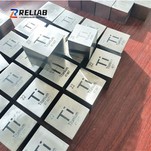
In the machining and production of titanium alloy components, issues such as burrs on edges and corners, surface oxidation layers, machining marks, and uneven micro-roughness are key challenges that affect product appearance, assembly precision, and operational stability. Traditional grinding methods are inefficient, prone to human error, and struggle to handle irregular shapes and hard-to-reach areas. In contrast, the oscillatory grinding and polishing process-with its high adaptability, uniform processing, non-damaging effect on the base material, and suitability for mass production-has become a widely adopted precision finishing technology for irregularly shaped and complex titanium alloy components.
I. Core Principles of the Process
Oscillatory grinding and polishing of titanium alloys is a wet, integrated finishing process. Its core principle involves completely submerging the titanium alloy workpiece in a predetermined quantity of pre-formulated abrasive, combined with a specialized water-soluble grinding and polishing additive. Utilizing the high-frequency oscillatory motion of the equipment, this process creates continuous, uniform relative friction between the abrasive, the polishing solution, and the workpiece. Under the influence of high-frequency reciprocating oscillation, the abrasives continuously perform micro-grinding-in a uniform manner-on areas of the titanium alloy workpiece that are difficult to machine manually, such as surfaces, edges, corners, holes, grooves, and hard-to-reach areas. This process gradually removes machining burrs, sharp edges, rust, and oxide layers, while smoothing out surface tool marks and scratches. Ultimately, it achieves comprehensive chamfering, leveling, and precision polishing of the workpiece, resulting in a high-quality surface that is uniformly fine-grained and consistent in luster. The entire process employs flexible grinding without any hard impacts, maximizing the protection of the titanium alloy substrate's dimensional accuracy. It prevents workpiece deformation, dents, and scratches, making it suitable for the precision finishing requirements of various high-precision titanium alloy components.
II. Diverse Abrasive Selection and Application
Abrasives are the core medium determining the polishing results of titanium alloys. Depending on the hardness of the titanium material, the workpiece structure, and processing requirements, the process can flexibly select a single abrasive or a blended mixture of abrasives, offering exceptional adaptability.
1. Mainstream Hard Abrasive Materials Common materials include aluminum oxide (fused, sintered, and natural), corundum, quartz, ceramics, and plastics. With a wide range of hardness levels, these materials can meet both the demands of powerful deburring and fine mirror-finish polishing.
2. Abrasive Shape and Structure: The industry generally uses preformed abrasives, which are manufactured into regular shapes such as double-beveled, cylindrical, and rhombic forms. Compared to natural, irregular abrasives, preformed abrasives provide uniform grinding force, stable wear rates, higher processing efficiency, and greater cost-effectiveness, making them the preferred solution for batch precision machining of titanium alloys.
3. For the rust removal, scale removal, and rough leveling processes of titanium alloys, auxiliary grinding materials-such as pumice, quartz, granite particles, shell particles, iron filings, and ceramic fragments-can be used to rapidly remove thick oxide layers and stubborn stains from the workpiece surface. Key Principles for Selection: The abrasive particle size must be compatible with the workpiece's holes and crevices. Precisely match the abrasive specifications to the workpiece's size, shape, and depth of dead corners to avoid issues such as material jamming, uneven grinding, localized over-polishing, and polishing blind spots.
III. Process Ratios and Key Operating Procedures
The quality of finished products produced through vibratory grinding and polishing depends heavily on the filler ratio, solution composition, and operational details, which are critical to stable, mass production.
1. Abrasive Filling Volume: The total volume of abrasives and workpieces inside the drum is typically controlled at 70% of the drum's capacity. A moderate filling volume ensures sufficient space for abrasive movement and uniform friction, preventing movement impediments caused by overfilling and insufficient polishing intensity caused by underfilling.
2. Polishing Solution Proportions: The volume of water-soluble polishing solution added should account for approximately 95% of the drum's volume. This ensures that the workpieces and abrasives are fully immersed, enabling uniform wet grinding.
3. Safe Handling of Acidic Solutions: If the process requires the addition of acidic additives to enhance descaling and passivation effects, water must be added first, followed by acid. Direct addition of acid is strictly prohibited to prevent localized corrosion of titanium alloy workpieces by high-concentration acid solutions, which could cause surface damage.
4. Solution Replacement Interval: As processing time increases, the concentration of the polishing solution will continue to decrease and its activity will decline, gradually reducing the effectiveness of the grinding and polishing process. It is necessary to regularly test the concentration and replace the solution in a timely manner to ensure consistent product quality across batches.
IV. Processing Time and Quality Control
There is no fixed, uniform processing time for oscillatory grinding of titanium alloys; the processing duration ranges from several minutes to several hours. Processing time, abrasive type, and solution concentration must be carefully balanced. Optimal process parameters should be determined through experimental calibration based on the condition of the titanium alloy, surface roughness requirements, burr size, and desired polish grade. Once parameters are precisely matched, the process achieves a high-precision finish with a uniform surface luster, free of dead spots and scratches, and with exceptional consistency.
V. Material Recovery and Recycling
This process offers the advantages of being environmentally friendly, energy-efficient, and suitable for low-cost mass production. Upon completion of processing, the workpieces and abrasives are discharged together and rapidly sorted using specialized screening and separation equipment. Qualified, undamaged abrasives can be recovered and reused in production, significantly reducing consumable costs and making the process well-suited for enterprises engaged in high-volume, routine titanium alloy finishing operations.
This process overcomes the limitations of traditional polishing; it is not constrained by workpiece size, shape, or structural complexity, and can complete the entire process-including deburring, chamfering sharp edges, rust and scale removal, surface leveling, and fine polishing-of titanium alloy workpieces in a single step. The process features flexible machining throughout, prevents deformation, does not damage the base material, ensures full coverage of hard-to-reach areas, delivers consistent finished products, and supports mass production. It is widely applicable for the surface finishing of various titanium alloy components, including those used in aerospace, medical devices, precision mechanical parts, and consumer titanium products. It is currently the mainstream process in the field of titanium alloy finishing, offering high efficiency, stability, and cost-effectiveness.


 E-mail: garychen3215@hotmail.com
 Address: No.35, Baoti Rd, Baoji city, Shaanxi Province, China
 Contact: Mr. Gary Chen
 Phone: +86-917-8883215
 Mobile/WhatsApp: +86 13092900605