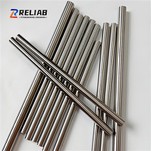
Titanium is a strategic emerging material that underpins the nation's high-end manufacturing and national defense development. Thanks to its high strength, low density, and corrosion resistance, it is indispensable in key sectors such as aerospace, marine engineering, new energy, and biomedicine. China accounts for 35%, 72.6%, and 68% of global production of titanium ore, sponge titanium, and titanium materials, respectively, firmly maintaining its position as the world's largest producer and consumer of titanium, and playing a pivotal role in the global industrial economy.
1. Global Titanium Ore Reserves:
Global titanium ore reserves consist primarily of ilmenite (accounting for over 90%) and, to a lesser extent, rutile. By 2025, ilmenite reserves are projected to reach 490 million metric tons, while rutile reserves are projected to reach 49 million metric tons. Ilmenite reserves are highly concentrated in three countries-Australia (34.69%), China (22.45%), and Canada (10.2%)-which together account for over 67% of the total; rutile reserves are concentrated in Australia (over 70%), South Africa, Ukraine, and Mozambique.
Global Titanium Sponge Supply
In 2025, global titanium sponge production is projected to reach approximately 387,300 metric tons, with titanium materials production at approximately 269,000 metric tons. China accounts for 72.6% and 68% of these figures, respectively, making it the absolute core of the global supply. However, the supply situation is characterized by "abundant total volume but structural imbalance": there is overcapacity in low- to mid-range sponge titanium, while the combined output of aerospace-grade sponge titanium from Japan, Kazakhstan, Russia, and Saudi Arabia fell by 12% year-over-year to 95,000–106,000 metric tons, resulting in a contraction in the supply of high-end aerospace-grade sponge titanium. Global titanium metal supply is highly dependent on China, but pricing power for high-end products remains in the hands of overseas companies.
Titanium Demand
1. Global Titanium Demand: In 2025, global consumption of metallic titanium (titanium materials) is projected to reach approximately 280,000 metric tons, characterized by a pattern of "aerospace as the dominant sector, followed by chemicals and marine applications, with regional variations": Titanium used in aerospace will account for approximately 95,000–101,000 metric tons (34%–36% of the total), making it the largest consumption sector; the chemical industry will account for approximately 72,000 metric tons (with a steady growth rate of 6.2%), and marine engineering and shipbuilding will account for approximately 31,000 metric tons. Regionally, North America, with approximately 95,000 metric tons (29.6% of the total), remains the largest market, while China's consumption of 72,000 metric tons (up 15.3% year-over-year), accounting for 25.7% of the global total, makes it the fastest-growing single market.
2. Titanium Demand in China
China is the world's largest consumer of titanium materials. In 2025, titanium material consumption is projected to reach approximately 162,000 metric tons (up 7.2% year-over-year), while consumption of titanium alloys and titanium-based materials is projected to reach approximately 170,000 metric tons (up 17.2% year-over-year). The consumption structure is characterized by "chemicals as the main sector, with aerospace as a secondary sector": the chemical sector accounts for 45.3%-the largest segment-while aerospace accounts for 19.0% and continues to grow; sectors such as shipbuilding, offshore engineering, and medical applications are also growing rapidly. Overall, the industry faces an oversupply in the low- to mid-end segments, while a structural shortage persists in high-end titanium alloys. During the upcoming "15th Five-Year Plan" period, the balance between high-end and low- to mid-end demand is expected to undergo a fundamental reversal.


 E-mail: garychen3215@hotmail.com
 Address: No.35, Baoti Rd, Baoji city, Shaanxi Province, China
 Contact: Mr. Gary Chen
 Phone: +86-917-8883215
 Mobile/WhatsApp: +86 13092900605