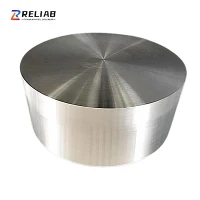
Can titanium alloy round bars be forged? This is a question that often comes up among manufacturers, engineers, and those involved in various industries that rely on titanium alloy products. As a supplier of Titanium Alloy Round Bars, I'm here to shed light on this topic and provide you with in - depth insights.
The Basics of Titanium Alloy Forging
Titanium alloys are well - known for their exceptional properties, such as high strength - to - weight ratio, excellent corrosion resistance, and good biocompatibility. These properties make them highly sought - after in industries like aerospace, medical, automotive, and marine.
Forging is a manufacturing process that involves shaping metal by applying compressive forces, usually through the use of a hammer or a press. The question of whether titanium alloy round bars can be forged has a clear answer: yes, they can. However, forging titanium alloy round bars is not as straightforward as forging some other metals.
Titanium has a relatively low thermal conductivity compared to metals like aluminum or steel. This means that during the forging process, heat is not dissipated as quickly. As a result, precise temperature control is crucial. If the temperature is too high, the titanium alloy can oxidize, forming a hard and brittle oxide layer on the surface. On the other hand, if the temperature is too low, the alloy may not deform properly, leading to cracking or internal defects.
The Forging Process of Titanium Alloy Round Bars
The forging process of titanium alloy round bars typically starts with the selection of the appropriate raw material. We, as a supplier, offer a wide range of titanium alloy round bars, including Dental Implant Titanium Bars, ASTM F67 H9 Titanium Bar, and CP Titanium Bar. Each type of bar has different chemical compositions and mechanical properties, which will affect the forging process.
Before forging, the titanium alloy round bars need to be heated to the appropriate forging temperature. This temperature range varies depending on the specific alloy. For most common titanium alloys, the forging temperature is usually between 800°C and 1100°C. Special heating equipment, such as induction heaters or gas - fired furnaces, is used to ensure uniform heating.
Once the bars reach the right temperature, they are transferred to the forging press or hammer. The forging equipment applies a series of compressive forces to shape the bars into the desired form. The number of blows and the amount of deformation in each step are carefully controlled to ensure the quality of the final product.
After forging, the titanium alloy round bars go through a series of post - forging treatments. These treatments may include heat treatment to relieve internal stresses, machining to achieve the required dimensions, and surface finishing to improve the appearance and corrosion resistance.
Advantages of Forging Titanium Alloy Round Bars
There are several advantages to forging titanium alloy round bars. First of all, forging can improve the mechanical properties of the alloy. The compressive forces during forging align the grain structure of the metal, resulting in enhanced strength and toughness. This is particularly important in applications where the components need to withstand high loads and stresses, such as in aerospace engines or medical implants.
Secondly, forging allows for greater design flexibility. Complex shapes and geometries can be achieved through forging, which may not be possible with other manufacturing processes. This enables engineers to develop innovative products that meet the specific requirements of different industries.
In addition, forging can reduce material waste. Compared to machining from solid blocks, forging can use the material more efficiently, as it starts with a pre - shaped bar and only adds the necessary deformation. This not only saves costs but also has a positive impact on the environment.
Challenges in Forging Titanium Alloy Round Bars
Despite the many advantages, forging titanium alloy round bars also presents some challenges. As mentioned earlier, temperature control is a major issue. Maintaining the right temperature throughout the forging process requires precise monitoring and control systems. Any deviation from the optimal temperature range can lead to quality problems.
Another challenge is the high cost of forging equipment and raw materials. Titanium alloys are generally more expensive than other metals, and the specialized forging equipment needed for titanium is also costly. This makes the initial investment in forging titanium alloy round bars relatively high.
Moreover, the reactivity of titanium with oxygen and nitrogen at high temperatures requires a controlled environment during forging. Special atmospheres, such as argon or vacuum, are often used to prevent oxidation and nitride formation on the surface of the bars.
Applications of Forged Titanium Alloy Round Bars
Forged titanium alloy round bars have a wide range of applications. In the aerospace industry, they are used to manufacture critical components such as turbine blades, landing gear, and structural parts. The high strength - to - weight ratio and excellent corrosion resistance of forged titanium alloy bars make them ideal for these applications, where weight reduction and reliability are of utmost importance.
In the medical field, forged titanium alloy round bars are commonly used to make dental implants and orthopedic devices. The biocompatibility of titanium ensures that these implants can integrate well with the human body, while the high strength and toughness provide long - term durability.
The automotive industry also benefits from forged titanium alloy round bars. They can be used in high - performance engines, suspension systems, and other components to improve the overall performance and fuel efficiency of vehicles.


Conclusion
In conclusion, titanium alloy round bars can indeed be forged, although it requires careful control and expertise. The forging process offers many advantages, including improved mechanical properties, design flexibility, and material efficiency. However, it also comes with challenges such as temperature control, high costs, and the need for a controlled environment.
As a supplier of Titanium Alloy Round Bars, we have the experience and resources to provide high - quality bars suitable for forging. Whether you are in the aerospace, medical, automotive, or any other industry, we can offer you the right products to meet your needs.
If you are interested in our Titanium Alloy Round Bars or have any questions about the forging process, please feel free to contact us for more information and to start a procurement negotiation. We look forward to working with you to achieve your goals.
References
- "Titanium: A Technical Guide" by John R. Davis
- "Metal Forming: Processes and Applications" by G. E. Dieter
- "Materials Science and Engineering: An Introduction" by William D. Callister, Jr. and David G. Rethwisch