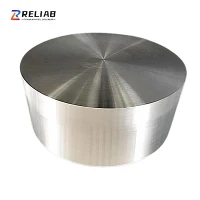
Hey there! As a supplier of titanium forgings, I often get asked about what elongation in titanium forgings means. So, I thought I'd take some time to break it down for you all.
First off, let's talk about what elongation is in general. Elongation is a measure of how much a material can stretch before it breaks. When we're talking about titanium forgings, it's a crucial property. You see, titanium is already known for its strength, light - weight, and corrosion resistance. But the ability of titanium forgings to elongate is also super important, especially in applications where the material might be subjected to stress that could cause it to deform.
Let's dig a bit deeper into the science behind it. Elongation is usually expressed as a percentage. We test it by taking a sample of the titanium forging, applying a tensile force (that's a pulling force), and measuring how much the sample stretches before it fails. The formula for elongation is:
Elongation (%) = [(Final Length - Initial Length) / Initial Length] x 100
For example, if a titanium forging sample starts at 100 mm in length and stretches to 120 mm before breaking, the elongation would be [(120 - 100) / 100] x 100 = 20%.
Now, why does this matter? Well, in industries like aerospace, where safety is paramount, a high elongation value is often desired. Aerospace components made from titanium forgings, such as Gr5 Titanium Aerospace Forgings, need to be able to withstand a lot of stress during flight. If the material has good elongation, it can deform to a certain extent without fracturing. This gives a bit of a safety margin, as the component can handle unexpected loads without suddenly breaking, which could lead to catastrophic consequences.
In the medical field, too, elongation plays a key role. Dental implants made from titanium forgings, like Dental Titanium Disc Grade 5, need to be able to adapt to the forces exerted during chewing. A titanium forging with appropriate elongation can better endure these forces over time, reducing the risk of implant failure.
Another factor that affects the elongation of titanium forgings is the manufacturing process. Forging is a process where we shape the titanium by applying compressive forces. The way we heat, hammer, and cool the titanium during forging can have a big impact on its final properties, including elongation. If the forging process is not carefully controlled, the grain structure of the titanium can be disrupted, which may lead to lower elongation values.
The chemical composition of the titanium alloy also matters. Different grades of titanium have different amounts of alloying elements, like aluminum, vanadium, and molybdenum. These elements can change the way the titanium behaves under stress. For instance, Grade 5 titanium (Ti - 6Al - 4V), which is one of the most commonly used titanium alloys, has a good balance of strength and elongation. It's used in a wide range of applications, from aerospace to medical, because it can meet the requirements of both high - stress environments and the need for some flexibility.
On the other hand, Gr7 Titanium Forged Ring is a different story. Grade 7 titanium has a higher content of palladium, which gives it excellent corrosion resistance. However, this also affects its mechanical properties, including elongation. The palladium can change the grain structure and the way the material responds to stress, so the elongation values for Grade 7 titanium forgings might be different compared to Grade 5.
When it comes to quality control, we at our company take elongation testing very seriously. We use state - of - the - art testing equipment to ensure that every batch of titanium forgings we produce meets the required elongation standards. This involves taking multiple samples from different parts of the forging and conducting tensile tests. If the results don't meet our strict criteria, we'll go back and adjust the manufacturing process to improve the properties of the forgings.
Now, you might be wondering how you can choose the right titanium forging with the appropriate elongation for your specific application. Well, it all depends on your needs. If you're in an industry where high strength and some flexibility are required, like aerospace or automotive, you might want to look at Grade 5 titanium forgings. But if corrosion resistance is your top priority, Grade 7 could be a better choice, even if it has slightly different elongation characteristics.
We're here to help you make that decision. Our team of experts has years of experience in the titanium forging industry. We can provide you with detailed information about the elongation and other properties of our titanium forgings, and help you select the best product for your project.
If you're interested in purchasing titanium forgings, whether it's for aerospace, medical, or any other application, don't hesitate to reach out. We're always happy to have a chat about your requirements and see how we can assist you. We offer high - quality titanium forgings at competitive prices, and we're committed to providing excellent customer service.


So, if you're in the market for titanium forgings, give us a chance to show you what we can do. Contact us today to start the conversation about your next project.
References
- Callister, W. D., & Rethwisch, D. G. (2017). Materials Science and Engineering: An Introduction. Wiley.
- ASM Handbook Committee. (2000). ASM Handbook, Volume 2: Properties and Selection: Nonferrous Alloys and Special - Purpose Materials. ASM International.