Titanium is a highly reactive metal that exhibits a strong affinity for gases such as oxygen, hydrogen, and nitrogen at high temperatures; this affinity becomes even more pronounced as the welding temperature rises, particularly during the titanium welding process. Practical experience has shown that if the absorption and dissolution of gases such as oxygen, hydrogen, and nitrogen by titanium are not controlled during welding, it will undoubtedly pose significant challenges to the fabrication of titanium welded joints.
I. Introduction
In recent years, with economic development-and particularly with the continuous deepening of reform and opening-up-China's economic construction has made tremendous progress. At the same time, China has also made significant strides in welding for engineering projects such as pipelines. Titanium welding is a relatively common type of welding, and ensuring effective quality control during the process has a crucial impact on the color of the titanium weld. Given the visual nature of titanium weld color, research into the relationship between weld color and weld quality holds significant importance. In this paper, the author draws upon years of research and practical experience in titanium welding quality control and process technology to explore the relationship between weld quality and weld color in titanium welding, with the hope of contributing to research in this field.
II. The Effect of Titanium's Properties on Titanium Welding
1. The Effect of Oxygen and Nitrogen
Oxygen and nitrogen are interstitially dissolved in titanium, causing lattice distortion. This increases resistance to deformation, as well as strength and hardness, but reduces plasticity and toughness. The presence of oxygen and nitrogen in the weld is undesirable and should be avoided.
2. The Effect of Hydrogen
An increase in hydrogen causes a sharp decline in the impact toughness of titanium weld metal, while plasticity decreases only slightly; hydrides can cause brittleness in the joint.
3. The Effect of Carbon
At room temperature, carbon is interstitially dissolved in titanium, increasing strength and decreasing plasticity, though not as significantly as with oxygen and nitrogen. when the carbon content exceeds the solubility limit, hard and brittle TiC is formed. This TiC distributes in a network-like pattern and is prone to cracking. Chinese national standards stipulate that the carbon content in titanium and its alloys must not exceed 0.1%. During welding, oil contamination on the workpiece and welding wire can increase the carbon content; therefore, thorough cleaning is required before welding.
III. Analysis of Titanium's Weldability
Titanium has good weldability. Due to its low thermal conductivity (0.041 Cal/°C·cm·s), titanium metal melts only within the arc zone and exhibits good fluidity; furthermore, it has a low coefficient of thermal expansion (8.6 × 10⁻⁶/°C, far lower than that of carbon steel), which significantly enhances the weldability of titanium metal.
IV. The Relationship Between Weld Color and Welding Quality in Titanium Welding
1. Color Changes in Welds of Titanium and Titanium Alloy Tubes and the Mechanism of Defect Formation
The defects in titanium and titanium alloy tubes and their mechanisms of formation are as follows: During the welding of titanium tubes, the argon gas shield formed by the TIG torch can only protect the weld pool from the harmful effects of air; it provides no protection for the weld and its surrounding areas that have already solidified but remain at high temperatures. However, titanium pipe welds and their surrounding areas in this state still have a strong ability to absorb nitrogen and oxygen from the air. Oxygen absorption begins at 400°C, and nitrogen absorption begins at 600°C, while the air contains large amounts of both nitrogen and oxygen.
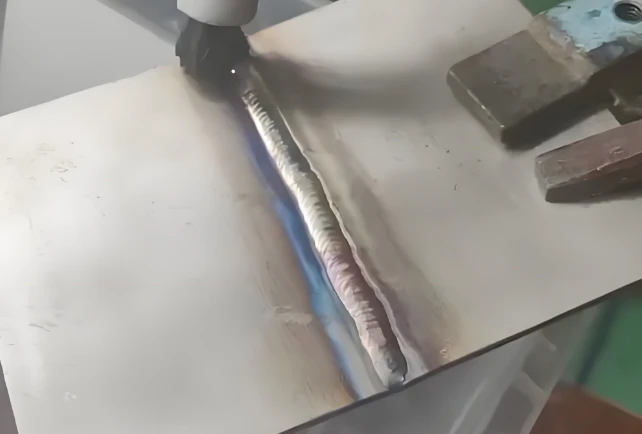
As the degree of oxidation gradually increases, the color of the titanium pipe weld changes, and the weld's ductility decreases. Silver-white (no oxidation); golden yellow (TiO; titanium begins to absorb hydrogen at approximately 250°C; slight oxidation); blue (Ti₂O₃; moderately severe oxidation); gray (TiO₂; severe oxidation).
2. The quality of titanium welds can be assessed based on the color of their surfaces.
The testing of different colors and hardness levels of titanium welds is illustrated in the figure below
(I) Experiments have demonstrated that as the weld color darkens-that is, as the degree of oxidation increases-the hardness of the weld also increases. According to tests conducted by peers, as the hardness of titanium increases, the concentration of harmful substances such as oxygen and nitrogen in the weld rises, significantly reducing weld quality.
(2) The weldability of titanium is closely related to its chemical and physical properties. However, the key issue is that at high temperatures, titanium's high reactivity makes it susceptible to atmospheric contamination. During heating, its grains expand, and as the welded joint cools, this leads to the formation of brittle phases. Titanium has a very high melting point, reaching 1668 ± 10°C, which requires even more energy than welding steel. At the same time, titanium is chemically very reactive and reacts with O and H much more readily than steel, undergoing rapid chemical reactions at temperatures above 600°C. It absorbs large amounts of H and O as early as 100°C, with a hydrogen solubility tens of thousands of times greater than that of steel, leading to the formation of titanium hydride and a sharp decline in toughness. Gaseous impurities increase the susceptibility to cold cracks and delayed cracks, as well as notch sensitivity. Therefore, the purity of argon used for welding should be no less than 99.99%, the moisture content should not exceed 0.039%, and the hydrogen content of the welding wire should be below 0.002%. Titanium's heat transfer coefficient is half that of steel. An α-to-β phase transformation occurs at 882°C; at higher temperatures, β grains undergo rapid, step-like growth, causing a significant deterioration in properties. Therefore, temperature must be strictly controlled, particularly the dwell time at high temperatures during the welding heat cycle. While hot cracking and intergranular cracking are not issues when welding titanium, porosity can occur, especially when welding α+β alloys.
V. Precautions for Titanium Welding
Based on the above research, the following issues must be addressed when welding titanium:
1. During the titanium welding process, the weld zone and post-weld heat-affected zone must be strictly shielded to prevent air from entering the weld and heat-affected zones, which could severely compromise weld quality. Therefore, 99.99% pure argon and a trailing shield are essential.
2. Weld grooves must be machined (grinding is not permitted);
3. Tacking should be avoided, and high-frequency arc initiation should be used.
4. Post-weld heat treatment should be avoided; if post-weld heat treatment is necessary, the heat treatment temperature should be below 650°C.
VI. Conclusion
Quality control in titanium welding has a significant impact on the color of the weld bead; at the same time, the quality of the weld can be assessed based on its color. There is a very important relationship between these two factors.
 E-mail: garychen3215@hotmail.com
 Address: No.35, Baoti Rd, Baoji city, Shaanxi Province, China
 Contact: Mr. Gary Chen
 Phone: +86-917-8883215
 Mobile/WhatsApp: +86 13092900605