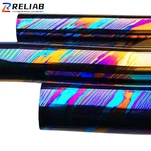
Extensive testing and application examples have demonstrated the significant technical and economic advantages of titanium tubes in power plant condensers. Economically, taking the tube diameter price of a 1000MW condenser nuclear power unit in Japan (approximately 50,000 condenser tubes) as an example, and calculating based on a 40-year condenser lifespan, the average annual leakage of aluminum-copper tubes is 10, while titanium tubes show no leakage over 40 years. This paper primarily discusses the problems encountered in the application of titanium tubes in power plants.
1. Corrosion Issues
Seawater is used as cooling water for condensers in coastal power plants. Due to the large amount of sediment, suspended solids, marine organisms, and various corrosive substances in seawater, the situation is more severe in the slightly brackish water where seawater and river water alternate. Traditional corrosion methods for copper platform metal pipes include overall corrosion (uniform corrosion), erosion, and stress corrosion. Titanium, with its excellent corrosion resistance, eliminates seawater leakage accidents caused by corrosion of titanium tube condensers. However, because titanium tubes are not as corrosion-resistant as copper alloy tubes, toxic substances can form on their surface. Therefore, marine organisms easily adhere to the inner wall of titanium tubes, affecting heat transfer efficiency. Thus, appropriate cleaning devices are required.
2. Hydrogen Absorption: Although titanium has a dense passivation film on its surface, providing high corrosion resistance in many highly corrosive media, it has a very high affinity for hydrogen. It readily absorbs hydrogen. This occurs at room temperature and rapidly at high temperatures (e.g., 100°C). The solid solubility limit of hydrogen in titanium is very small (approximately 20 ppm). If this limit is exceeded, hydrides (tth2) will precipitate on the titanium surface. With increasing surface titanium content, the impact value and elongation of titanium decrease rapidly. Furthermore, during the retrofitting of older units, because the tube sheets are made of copper alloy and the condenser tubes are made of titanium alloy, cathodic protection devices are required to prevent electrochemical corrosion. For example, the condensers in Hitachi power plants use seawater cooling, with titanium tubes paired with copper alloy plates. When the protection potential is below 0.75V (SCE), the outlet titanium tube end absorbs hydrogen, reaching a hydrogen content of 650 ppm after one year of use. If the potential is 0.5~0.75V (SCE), titanium does not absorb hydrogen at room temperature.
3. Vibration Issues: Zibo titanium tubes possess excellent corrosion resistance. While titanium condensers will not be damaged by corrosion leaks, titanium tubes can be damaged by vibration. To avoid vibration problems with titanium tubes, a suitable diaphragm spacing needs to be determined during the manufacturing of the titanium condenser; during the renovation of old units, it is necessary to investigate whether the original partition wall spacing is suitable for titanium tubes.

Baoji Reliab Metal Materials Co.,Ltd
Mobile: 0086 13092900605
Sales Department 1: WhatsApp +8613092900605 (Mr.Gary)
Sales Department 2: +8613092913521(Ms. Sophia)
Address: No.35 Baoti Rd, Weibin District, Baoji, China