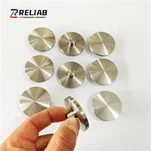
Titanium can certainly be drilled and tapped, but its unique physical and chemical properties make it much more difficult to machine than ordinary steels (such as 45 steel) or aluminum alloys. If improper methods are used, it is easy for the cutting tools to wear out quickly, chip, or even cause the workpiece to burn.
I. Why Is Titanium Difficult to Machine?
Poor thermal conductivity: Titanium has a very low thermal conductivity (approximately one-fourth that of iron). Most of the heat generated during drilling or tapping accumulates at the cutting edge and on the workpiece surface, rather than being carried away with the chips.
Low Modulus of Elasticity: Titanium undergoes elastic deformation when subjected to force. During tapping, it tends to "spring back" and grip the tap tightly, causing a sudden surge in torque that can snap the tap.
High Chemical Reactivity: At high temperatures, titanium readily reacts chemically with tool materials (such as cobalt and tungsten), causing "stick-to-tool" phenomena that lead to chipping of the cutting edge.
II. Key Points for Drilling
Tool Selection:
You must use carbide drill bits specifically designed for machining titanium alloys. Standard high-speed steel drill bits wear out extremely quickly.
A drill bit with a point angle of 130°–140° is recommended (compared to 118° for ordinary steel), as this provides greater strength and facilitates chip breaking.
Cutting Parameters:
Low surface speed: Recommended range is 10–25 m/min. For a common 10 mm drill bit, the spindle speed should be approximately 300–800 rpm.
High feed rate: 0.05–0.15 mm per revolution. Do not dry-cut at the bottom of the hole, as this causes severe work hardening.
Cooling and Lubrication:
High-flow, high-pressure water-based cutting fluid (emulsion or semi-synthetic fluid). Do not rely solely on an air gun for blowing, as heat buildup will immediately burn out the drill bit.
Special Techniques:
High-Speed Drilling Method: If conditions are limited, withdraw the drill immediately when 0.5 mm remains before fully penetrating the material to eliminate rebound compression, then drill through.
Avoid using extreme-pressure additives containing chlorides, as they may cause stress corrosion cracking in titanium.
III. Key Points for Tapping
Tapping is more difficult than drilling and represents a bottleneck in titanium machining. Taps are extremely prone to breaking when working with small-diameter threads (such as M3 and smaller).
Tap Selection:
Prioritize taps made of cobalt-containing high-speed steel or powder-metallurgy high-speed steel.
Flute Type: Helical flutes (for through holes) or helical-angle flutes (for blind holes) must be used. Straight-flute taps are generally unusable on titanium.
Taps should be designed with a large rake angle and a wide, asymmetrical flank to reduce springback friction.
Pilot Hole Diameter:
The pilot hole must be enlarged. Do not calculate it based on standard thread pilot hole specifications.
Empirical formula: Pilot hole diameter ≈ nominal thread diameter × 0.8. For example, for an M6×1.0 thread, a pilot hole of Ø5.0 mm is recommended (standard steel parts use Ø5.0, but for titanium, use Ø5.0–5.1).
The chamfer depth of the pilot hole must exceed one pitch.
Tapping Procedure:
Manual Tapping: After tapping 1/2 to 1 full turn, reverse the direction by 1/4 turn to break chips and release springback force. Never tap all the way to the bottom in one go.
Machine Tapping: Use a flexible tap chuck (with torque protection), and control the spindle speed between 5 and 15 RPM.
Lubrication:
Use pure mineral oil, castor oil, or a specialized titanium alloy tapping compound. Do not use ordinary machine oil or emulsion, as they do not provide sufficient lubrication.
Summary and Recommendations:
If you only have a standard hand drill or bench drill and no coolant:
Drilling: You can try this, but you'll need to lift the drill bit every 3–5 seconds and cool it by dipping a brush in diesel fuel or sewing machine oil.
Tapping: Not recommended. For threads smaller than M6, the probability of the tap breaking exceeds 80%. For small-batch production, we strongly recommend using thread milling (milling threads with a CNC milling machine) instead of tapping.


 E-mail: garychen3215@hotmail.com
 Address: No.35, Baoti Rd, Baoji city, Shaanxi Province, China
 Contact: Mr. Gary Chen
 Phone: +86-917-8883215
 Mobile/WhatsApp: +86 13092900605