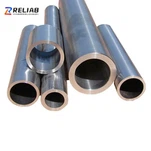
After cutting or machining, titanium rods, plates, and machined parts inevitably develop burrs, tool marks, and rough surfaces. Therefore, when it comes to surface finishing to achieve a smooth and lustrous finish, vibratory polishing is undoubtedly an excellent choice.
For deburring titanium bars, plates, and machined parts, an efficient mechanical method can be employed: the titanium material is submerged in a large quantity of abrasive media, with an appropriate amount of water-soluble grinding and polishing compound added. Using the principle of vibration, the abrasive media is thoroughly mixed with the workpiece and continuously agitated against it. Through the abrasive action of the media on the workpiece's surface and edges, this process achieves deburring, chamfering, rust removal, scale removal, surface leveling, and fine polishing. This technology is suitable for metal parts of various sizes and shapes.
Abrasive Selection: Materials such as aluminum oxide (including fused, sintered, or natural types), corundum, plastic, quartz, and ceramics may be used, either individually or in combination. To improve cost-effectiveness and grinding efficiency, abrasives are typically pre-formed into regular shapes such as triangles, cylinders, or diamonds, which yield better results than irregular shapes or natural abrasives. Select abrasives of appropriate specifications based on the shape and dimensions of the workpiece.
Common abrasives used in burnishing include pumice, quartz, granite, flint, seashells, iron filings, and ceramic fragments. The size of the abrasive particles should be either larger or smaller than the diameter of the holes in the part.
Loading and Solution Control: The amount of material loaded into the drum is a key factor affecting surface quality; it is generally recommended to fill the drum to 70% of its capacity. The solution should be added to approximately 95% of the drum's volume (Note: When adding acidic solutions, fill the drum with water first, then add the acid to prevent corrosion of the parts). As the tumbling time increases, the solution concentration will gradually decrease and may eventually become ineffective.
Processing time: This can range from a few minutes to several hours. The key is to determine the appropriate abrasive through testing to achieve a uniform, polished finish. Post-processing and equipment: Once processing is complete, the workpieces are discharged along with the abrasives. The workpieces are then separated and sorted, and the recovered abrasives can be reused. Vibratory finishing machines are available in two types: standalone and inline, which can be selected based on production requirements.


 E-mail: garychen3215@hotmail.com ; boantj@163.com
 Address: No.35, Baoti Rd, Baoji city, Shaanxi Province, China
 Contact: Mr. Gary Chan/Ms. Sophia
 Phone: +86-917-8883215
 Mobile/WhatsApp: +86 13092900605