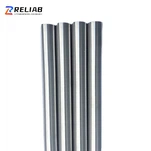
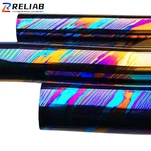
Titanium alloy welding is one of the welding methods.
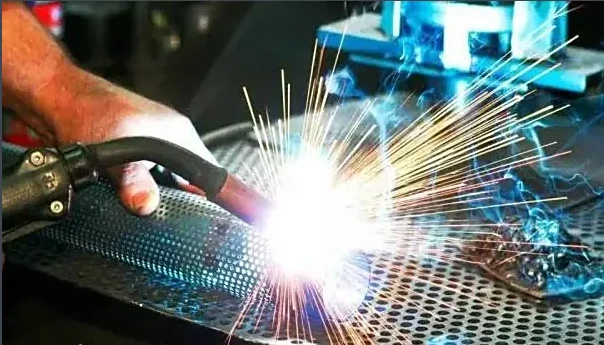
For thicknesses under 3 millimeters, tungsten inert gas welding is used; for thicknesses over 3 millimeters, gas metal arc welding is employed. The purity of argon gas shall not be less than 99.99%, and the content of air and water vapor in argon gas shall be strictly controlled.
Before welding, surface treatments such as oil removal, oxide scale removal and oxide film removal should be carried out. Due to the high chemical reactivity of titanium and titanium alloys, they are prone to contamination by oxygen, nitrogen and hydrogen. Therefore, welding methods such as shielded metal arc welding, oxygen-acetylene (or oxygen-propane, etc.) gas welding, CO2 welding and atomic hydrogen welding cannot be adopted.
1) The influence of oxygen and nitrogen:
The interstitial solution of oxygen and nitrogen in titanium causes lattice distortion of titanium, increasing its deformation resistance, strength and hardness, but reducing its plasticity and toughness. The presence of welding oxygen and nitrogen in the weld seam is unfavorable and should be avoided as much as possible.
2) The influence of hydrogen:
The increase of hydrogen will cause a sharp decline in the impact toughness of titanium weld metal, while the plasticity will decrease slightly. Hydrides will cause brittleness of the joint.
3) The influence of carbon:
At room temperature, carbon dissolves in titanium in the form of interstices, increasing its strength and reducing its plasticity, but not as significantly as oxygen and nitrogen. When the carbon content exceeds its solubility, it forms hard and brittle TiC, which is distributed in a network pattern and is prone to cracking. According to national standards, the carbon content in titanium alloys must not exceed 0.1%. During welding, oil stains on the workpiece and welding wire can increase the carbon content, so they need to be cleaned thoroughly during welding.
4) The formation of stomata:
The most common defect in the welding of titanium and titanium alloys is porosity, which mainly occurs near the fusion line. Hydrogen is an important cause of porosity formation. During welding, titanium has a strong ability to absorb hydrogen, and as the temperature drops, the solubility of hydrogen significantly decreases. Therefore, the hydrogen dissolved in the liquid metal often cannot escape in time, resulting in porosity.
Baoji Reliab Metal Materials Co.,Ltd
Tel: +86-917-8883215
Mobile: +8613092900605
+8613092913521
E-mail: garychen3215@hotmail.com