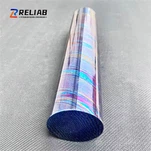
The GR5 titanium alloy (also known as Ti-6Al-4V) is widely used. However, due to its poor thermal conductivity (approximately 1/7 of that of steel) and high chemical reactivity at high temperatures, it is a typical difficult-to-machine material. Its machining methods are mainly divided into two categories: traditional cutting processing and special processing.
Traditional cutting processing
This is the most commonly used processing method. The key lies in selecting the appropriate tools and cutting parameters, along with adequate cooling and lubrication.
Turning (Drilling): The most basic processing method, used for machining the outer circle, inner hole, and end face of shafts, discs, and other rotating body parts. During rough machining, coated hard alloy tools (such as PVD TiAlN/AlTiN coatings) are commonly used, with a recommended cutting speed of 40-60 m/min and feed rate of 0.15-0.25 mm/r; during fine machining, the cutting speed can be increased to 50-80 m/min and the feed rate reduced to 0.08-0.15 mm/r.
Milling (Milling): Used for machining planes, grooves, complex surfaces, and various special-shaped parts. For complex curved surface parts like impellers, five-axis high-speed milling processing is highly suitable. Whether it's micro-milling for micrometer-level precision or processing of large structural components, milling plays an important role.
Drilling (Drilling): Used for machining various holes. Deep hole processing is a challenge, and deep hole drills or wire cutting are often used to ensure quality.
Grinding (Grinding): Used to obtain high precision and low roughness surfaces. However, grinding is one of the most challenging aspects in GR5 processing, mainly due to the material's tendency to adhere to the grinding wheel, rapid wear of the abrasive particles, and the grinding heat that can cause burn and micro-cracks in the workpiece.
Thread and gear processing: Outer threads can be formed by rolling; inner threads or high-precision threads are mostly completed by tapping or CNC turning.
1. First, distinguish between two types of processing modes (with significant differences):
1. Ordinary three-axis CNC milling (sheet materials / titanium structural components, milling shapes, drilling holes) • General economic tolerance: ±0.02 to ±0.05 mm • High-quality fixtures + fine processing: ±0.01 to ±0.02 mm • Limiting stable tolerance: ±0.008 mm (small size, short offset, multiple fine milling, cost significantly increases) Weaknesses: TC4 thermal conductivity difference, prone to tool breakage, large length-to-width ratio thin-walled parts have tolerance expanded to ±0.05 to 0.10 mm
2. Core drilling machine / automatic lathe (bar stock turning, micro shafts, parts, titanium screw blanks, mainstream process in Shenzhen Zhongke Hardware) • Economic mass production tolerance: ±0.005 to ±0.02 mm • High-precision fine processing (coordinated position): ±0.002 to ±0.005 mm • Limiting controllable size: ±0.001 mm (coordinated with special measuring tools, strictly controlling cutting parameters, temperature-controlled workshop, mostly used for 3C, watch and wearable accessories)
2. Detailed Dimension Tolerance Reference (Industry Standard)
Processing Method | Dimension Range | Standard Mass Production Tolerance | High-Precision Custom Tolerance:
3-Axis CNC Milling | <20mm | ±0.02~±0.03 | ±0.010~±0.015
3-Axis CNC Milling | 20–100mm | ±0.03~±0.05 | ±0.015~±0.025
Bar Turning on Walking Tool Holder | φ0.8~φ10mm Micro Titanium Parts | ±0.005~±0.015 | ±0.001~±0.005
III. Geometric Tolerance Reference
1. Flatness: Standard precision milling – 0.02/100mm; high precision up to 0.005/100mm
2. Roundness / Cylindricity (Turning): Standard – 0.003–0.008mm; parts within 0.0015mm
3. Perpendicularity, Parallelism: Standard ±0.02mm; fixture-based ±0.008mm
IV. Key Challenges Affecting GR5 Tolerance Accuracy
1. High elasticity of titanium alloy and tool deflection during cutting: thin-walled parts and slender shafts are difficult to maintain dimensional tolerance
2. High cutting temperature: thermal deformation directly affects dimensional stability
3. Cooling solution: tool material and feed/speed parameters directly determine product consistency.


 E-mail: garychen3215@hotmail.com
 Address: No.35, Baoti Rd, Baoji city, Shaanxi Province, China
 Contact: Mr. Gary Chen
 Phone: +86-917-8883215
 Mobile/WhatsApp: +86 13092900605