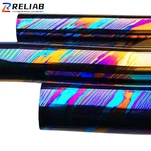
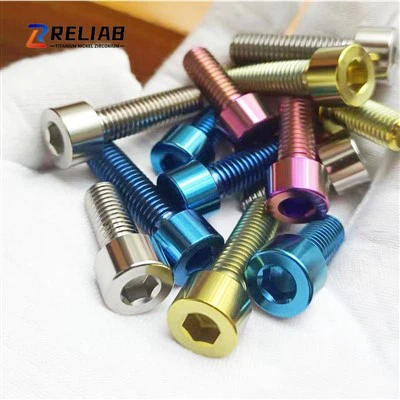
Many people have questions about the durability of the finish on anodized titanium alloys: Will products treated with this process peel like painted parts? In fact, the answer isn't simply "yes" or "no"-while anodized titanium alloys do not peel off in large sheets like paint, they may exhibit a "fading" effect under extreme conditions; the two phenomena are fundamentally different.
I. Why Doesn't It "Peel" Like Paint?
The Fundamental Difference Lies Here: Anodizing and spray painting are entirely different processes, which means there is no risk of traditional "peeling": Anodizing creates a film that "grows" from the surface, rather than an applied coating. Through electrochemical treatment, anodizing directly converts atoms on the surface of the titanium alloy into a layer of titanium dioxide (TiO₂). This film bonds with the base metal at the atomic level, with no distinct interface; it is essentially an extension that "grows" from the material itself. In contrast, spray painting is akin to putting a "coat" on the material; the paint physically covers the surface and bonds to the substrate solely through adhesion. Over time or with repeated impacts, it is prone to peeling off in large patches, flaking, or blistering. The color results from a physical effect, with no pigment layer. The color of anodized titanium alloy stems from the interference effect of the thin film: oxide layers of varying thicknesses produce different interference patterns with light, resulting in a rich spectrum of colors. Since no pigments are added during the entire process, there is naturally no issue of pigment layers peeling off.
II. Under what circumstances does it "appear to have faded or lost its finish"? Although it does not experience paint-like peeling, under extreme conditions, the anodized coating on titanium alloys can suffer wear and corrosion, resulting in visual changes that resemble "fading." There are two main scenarios:
1. Mechanical Wear (Most Common) The thickness of the anodized coating on titanium alloy is typically only tens to hundreds of nanometers. Although its hardness is higher than that of ordinary paint, it is still lower than that of the titanium alloy substrate. Under prolonged friction, scratching by hard objects, or repeated impacts, the coating will gradually become damaged:
Mild wear: The coating thins, causing the color to lighten or appear dull; for example, dark blue may turn light blue, and gold may fade to a pale yellow. Severe wear: The coating is completely worn through, exposing the titanium alloy's inherent silver-gray color, which looks as if a "patch of color has been lost." However, normal usage scenarios such as everyday handling or light wiping will not cause the coating to wear away.
2. Chemical Corrosion: Prolonged exposure to strong acids, strong alkalis, or environments with high concentrations of chloride ions (such as seawater or 84 disinfectant) can slowly corrode the anodized coating, leading to issues such as spotting, darkening, and localized discoloration. Visually, this may resemble "fading," but it is actually a result of the coating being corroded and is fundamentally different from paint peeling.

 E-mail: garychen3215@hotmail.com
 Address: No.35, Baoti Rd, Baoji city, Shaanxi Province, China
 Contact: Mr. Gary Chen
 Phone: +86-917-8883215
 Mobile/WhatsApp: +86 13092900605