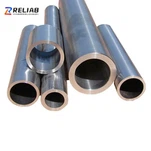
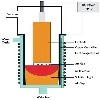
Titanium and titanium alloys naturally form a dense TiO₂ passivation layer approximately 2–10 nm thick when exposed to air, which is the source of their excellent corrosion resistance. Anodizing is an electrochemical process in which an **external electric field** is applied to artificially accelerate and control the growth of the oxide film in an electrolyte solution, with the titanium workpiece serving as the anode and an inert conductor (stainless steel or graphite) serving as the cathode.
The thickness of the oxide film is approximately proportional to the applied voltage. Empirical formula: Film thickness d (nm) ≈ 1.6 × voltage V (conventional sulfuric acid/phosphoric acid systems)
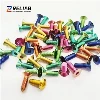
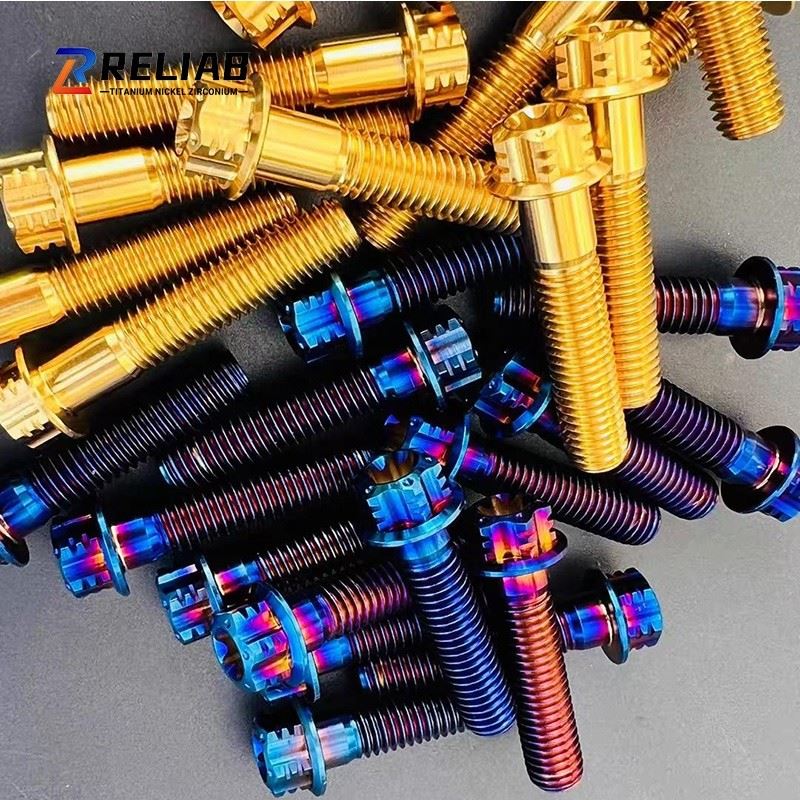
The color results from the optical interference effects of the thin film-TiO₂ films of different thicknesses produce constructive or destructive interference with visible light of different wavelengths, thereby displaying a complete color spectrum ranging from bronze, purple, blue, and green to yellow. This is not dye-based coloring but structural color, and therefore it never fades (unless the film layer is physically damaged).
Pickling and Activation (Key Step)
The natural passivation film on the titanium surface must be removed; otherwise, the oxide film will grow unevenly and result in mottled coloring.
HF + HNO₃ mixed acid | HF 2–5% + HNO₃ 15–30% (by volume) | Room temperature | 30–60 s | Most commonly used; removes the film quickly; requires ventilation and protective measures
Standard Anodizing Parameters
| Parameters | Recommended Range | Key Control Points |
|---|---|---|
| Voltage | 10–120 V DC(Set According to Target Color) | Voltage determines color and is the primary control variable; constant-voltage mode is required. |
| Current Density | 0.5–2 A/dm² | The current determines the film-forming rate; the current is high initially, but drops sharply once the film is formed. |
| Temperature | 10–35 ℃,Optimal: 20–25 °C | Excessively high temperatures accelerate film dissolution and cause the color to darken; ±1–2 °C ensures reproducibility. |
| Time | 30–90 s | Once the voltage stabilizes, the current drops to near zero, indicating that the film has reached its full length; 60 seconds is usually sufficient. |
| Stirring | Slight air agitation or cathode movement | Ensure uniform concentration and prevent localized overheating |
Post-Treatment: Sealing and Dyeing
1 Sealing Treatment
Conventional anodized coatings are thin and dense and generally do not require sealing. However, **thick coatings / hard anodized coatings** are porous and can be treated as follows:
- **Boiling Water Sealing**: Boil in deionized water for 10–20 min to form hydrated titanium oxide
- **Dichromate Sealing**: K₂Cr₂O₇ at 50–80 g/L, 90–95 °C, for 10–15 min (offers the best corrosion resistance, but chromium content is restricted)
- **Nickel salt / nickel acetate sealing**: An environmentally friendly alternative
2. Electrolytic Coloring (Secondary Coloring)
Building upon the anodizing process, metal salts (Ni, Sn, Co) are deposited within the porous film using alternating current to produce colors-such as black and antique bronze-that cannot be achieved with interference colors. Black titanium oxide is commonly used in optical components and the defense industry.
Applications
1. Medical Devices: Color-coding of surgical instruments (different colors to distinguish sizes/models), dental implants, orthopedic implants (MAO coating promotes osseointegration)
2. Aerospace: Identification and corrosion-resistant reinforcement of fasteners, bolts, and hydraulic system components
3. Chemical Processing Equipment: Corrosion- and wear-resistant treatment of reactor linings, heat exchanger tubes, and valve sealing surfaces
4. Consumer Electronics / Jewelry: Colorful decoration of watch cases, eyeglass frames, and titanium jewelry
5. Sporting Goods: Titanium bicycle frames, golf clubs, and mountaineering equipment
6. Electrochemical Industry: DSA anode substrate pretreatment (surface roughening and oxidation prior to titanium anode coating)

 E-mail: garychen3215@hotmail.com
 Address: No.35, Baoti Rd, Baoji city, Shaanxi Province, China
 Contact: Mr. Gary Chen
 Phone: +86-917-8883215
 Mobile/WhatsApp: +86 13092900605