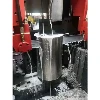
Titanium alloys are increasingly used in aerospace structural components, aerospace engine parts, and new energy equipment due to their high specific strength, strong heat resistance, and excellent corrosion resistance. However, titanium alloys have low thermal conductivity (approximately 7 W/(m·K)), low elastic modulus, and high chemical reactivity, which can easily lead to problems such as concentrated cutting temperature, chip adhesion to saw teeth, and accelerated saw blade wear during sawing. Properly setting sawing parameters is key to balancing processing quality and efficiency.
I. Core Process Parameters and Setting Principles
1. Band Saw Speed The band saw speed for titanium alloy cutting is typically set in the range of 15~30 m/min. Speed selection requires comprehensive consideration:
• Material grade: Pure titanium (GR2) has relatively good thermal conductivity, so the upper limit can be selected; α+β type titanium alloy (GR5) has high strength and poor thermal conductivity, so it should be reduced to 15~20 m/min.
• Heat treatment state: Solution-treated and aged state has higher hardness than annealed state, so the linear speed should be reduced by 10%~15%.
• Band saw rigidity: For equipment with weak rigidity, the speed needs to be further reduced to prevent vibration. Core principle: Too low a speed affects efficiency, while too high a speed will cause the cutting temperature to rise sharply, aggravating chip adhesion and tooth tip oxidation wear. It is recommended to use the chip color during test cuts as a reference-silver white is normal, light blue indicates the speed is too high, and dark blue or black indicates the speed is seriously too high.
2. Feed Speed The feed speed determines the feed per tooth, which directly affects the tooth tip load and chip removal status. The recommended feed rate range for titanium alloy sawing is 30~80 mm/min.
• For bars or thick plates: use the lower-middle limit of the feed to prevent skew cutting.
• For thin-walled pipes or small-section profiles: the feed can be appropriately increased, but tooth tip wear needs to be monitored. • Judgment criteria: During normal sawing, the chips are short and curled. If they are powdery, it indicates that the feed is too small and the tooth tips are scraping rather than cutting; if they are continuous long curls accompanied by vibration, it indicates that the feed is too large.
3. Coolant and Concentration Control Titanium alloy sawing requires sufficient coolant, mainly for cooling, lubrication, and chip removal. Recommended solutions:
• Water-based emulsion: concentration controlled at 5%~8%, suitable for ordinary bimetallic saw blades;
• For carbide saw blades cutting difficult-to-machine materials such as GR5: the concentration is recommended to be increased to 10%~12% to enhance extreme pressure lubrication performance.
• The coolant spray direction should be aligned with the saw entry point, and the flow rate should not be less than 20 L/min to ensure that the chips are promptly removed from the tooth grooves and avoid secondary cutting.
4. Saw Blade Selection: The choice of saw blade directly affects service life and cut quality:
• Pure Titanium (GR1, GR2): Use bimetallic band saw blades with M42 cobalt high-speed steel tips. Variable pitch teeth are recommended to reduce resonance.
• Titanium Alloy (GR5, TC4, TA19): Carbide-tipped band saw blades are recommended. Their red hardness can reach over 800℃, effectively resisting high-temperature wear during titanium alloy sawing. Split tooth profiles are preferable for chip removal.
• The number of teeth should follow the principle of "at least 3 teeth in simultaneous engagement" to prevent single-tooth overload.
5. Cutting Depth (Feed): When sawing large-section titanium alloy blanks, the depth of each cut should not be too large. A radial feed rate of 0.02~0.05 mm/tooth is recommended. Deep sawing can easily lead to:
• A surge in cutting force, causing workpiece displacement or loosening of the clamp;
• Saw blade twisting, causing slanted cuts;
• Poor chip removal from the tooth grooves, accelerating saw tooth breakage.


 E-mail: garychen3215@hotmail.com
 Address: No.35, Baoti Rd, Baoji city, Shaanxi Province, China
 Contact: Mr. Gary Chen
 Phone: +86-917-8883215
 Mobile/WhatsApp: +86 13092900605