


Why Titanium Is the Default Choice for Corrosive-Service Heat Exchangers
Power plant surface condensers, multi-stage flash (MSF) and MED desalination evaporators, chlor-alkali coolers, and offshore process exchangers share one enemy: hot seawater and brine carrying chloride ions that rapidly destroy carbon steel and even stainless steel through pitting and crevice corrosion.
Titanium solves this decisively. Its passive TiO₂ surface film self-repairs instantly when scratched, holding corrosion rates in seawater below roughly 0.02 mm per decade across a wide chloride concentration and pH range. Because titanium is immune to chloride pitting and erosion-corrosion at seawater velocities up to ~20 m/s, exchanger designers can specify thinner tube walls, smaller tube bundles, and higher flow rates than copper alloys allow. The result is a compact, long-life exchanger: titanium bundles routinely outlast 20–30 years of service where copper-nickel needs replacement within a decade.
But this performance only materializes when the right grade is matched to the right service environment, and the material is produced and tested to the correct ASTM product standards.
Material Options: The Nine Grades That Matter
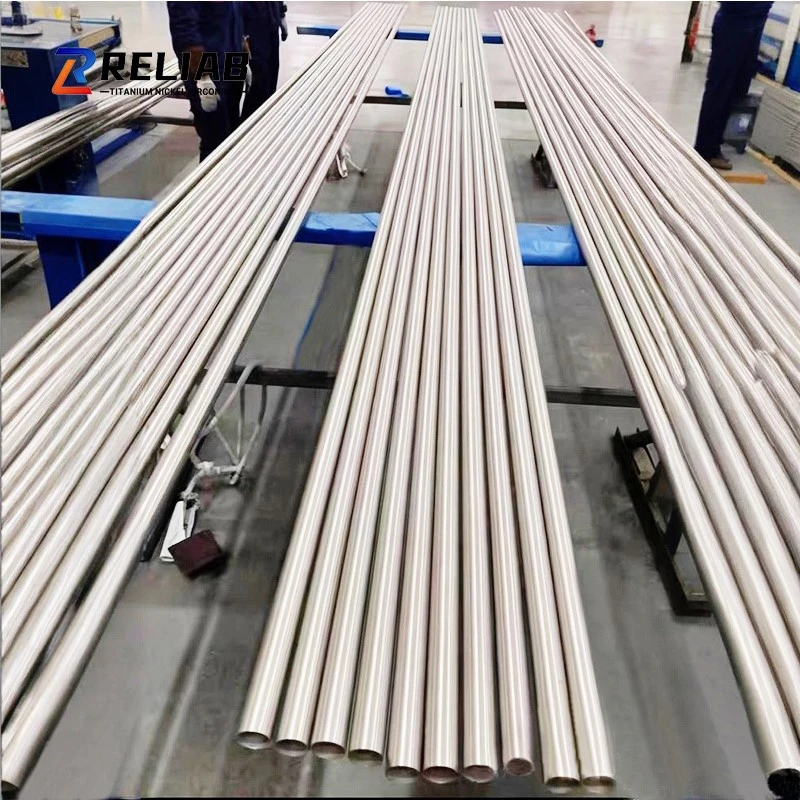
Industrial-heat-exchanger titanium is essentially a family of unalloyed and lightly alloyed grades, each defined by its chemistry in ASTM B265 (current edition B265-25) and delivered in tube form under ASTM B338 (current edition B338-17 (2026)) - the master specification for seamless and welded titanium tubes for surface condensers, evaporators, and heat exchangers.
The practical selection logic is straightforward:
Clean seawater and most chloride service: Grade 2 covers the majority of condenser, desalination, and chemical-plant tubing.
Hot brine with deposits or tight crevices (under-support-plate fouling, MSF flash chambers): upgrade to the palladium-modified Grade 7 (or lower-cost Grade 16) or the ruthenium-modified Grade 26, which suppress crevice corrosion attack.
Reducing acid duty (dilute HCl, H₂SO₄, sour gas condensate): Grade 7 or Grade 12 - plain CP titanium alone is not sufficient.
Pressure-vessel code designs needing a higher allowable stress: specify the H-variant (2H, 7H, 26H), which guarantees 400 MPa minimum tensile strength.
Welded tube (made from B265 strip and fully cold-worked to refine the weld structure) is the economic default for standard condenser sizes; seamless tube (from hollow billet) is specified for heavier walls, tighter corrosion margins, or client requirements in critical service.
|
Product Form |
ASTM |
Current Edition |
Notes |
|
Heat exchanger & condenser tubes |
B338 |
B338-17 (2026) |
Covers 28 grades; NDT (UT/eddy-current) and hydro/pneumatic tests required |
|
Strip, sheet & plate (shells, tubesheets, baffles) |
B265 |
B265-25 |
Tubesheet plate commonly Gr.2 or Gr.7 to match tube grade |
|
Bars & billets |
B348 |
B348-25 |
Fasteners, tie-rods, internal hardware |
|
Forgings (tubesheets, flanges) |
B381 |
B381-26 |
Large tubesheets for power condensers |
|
Welded fittings |
B363 |
Current edition on request |
Elbows, tees, reducers for titanium piping
|
How to Specify Titanium Heat-Exchanger Material
Match the grade to the environment, not to habit - confirm chloride concentration, temperature, pH, and crevice/fouling exposure before defaulting to Grade 2.
State standard and edition - "ASTM B338" for tubes, "ASTM B265" for plate; add "to ASME SB-338" if the vessel is Code-stamped.
Define tube manufacture route - welded or seamless - plus dimensions, wall tolerance, and the mandatory non-destructive test (ultrasonic or eddy-current) class.
Require hydrostatic or pneumatic test evidence and a flattening/reverse-flattening test report for welded tubes.
Demand full traceability - EN 10204 3.1 mill certificates with heat analysis (oxygen and hydrogen especially), tensile results, and heat numbers that survive the audit trail from mill to installed bundle.
About RELIAB METAL
RELIAB METAL CO LTD is a titanium manufacturer with 15 years of forging and materials expertise, supplying titanium tubes, plates, bars, forgings, and machined parts for power generation, desalination, chemical processing, and marine applications. We deliver Grade 1/2 CP titanium and Gr.7/12/26 corrosion-resistant grades to ASTM B338 and B265 with complete mill certification and heat-lot traceability. Send us your heat-exchanger drawings and service conditions for a grade recommendation, technical proposal, and quotation.

 E-mail: garychen3215@hotmail.com
 Address: No.35, Baoti Rd, Baoji city, Shaanxi Province, China
 Contact: Mr. Gary Chen
 Phone: +86-917-8883215
 Mobile/WhatsApp: +86 13092900605


