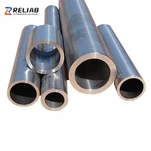
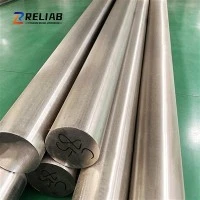
Technical Feature of Grade 9 Titanium forged billets
The manufacturing process of Grade 9 Titanium forged billets involves various forging techniques, including but not limited as open die forging, closed die forging, free forging and isothermal forging.
The selection of these processes depends on the type of titanium alloy, the complexity of the required components, and the requirements of the final application. During the forging process, precise control of temperature and deformation rate is of vital importance to ensure the micro-structure and performance of the forgings.
Main Forging Methods of Grade 9 Titanium forged billets
1). Free Forging
Suitable for simple shape, low precision requirement forgings, dependent on manual operation, low material utilization rate. Strong process flexibility, but strict control of deformation and hammering frequency.
2). Die/Mould Forging
Open die forging: Use a die with a flash groove, control the metal flow in stages, remove the flash at the end of forging, suitable for mass production of complex-shaped forgings.
Closed die forging: No flash design, high material utilization rate, better PRECISION, but strict requirements for die strength and temperature control.
3). Extrusion and Rolling
Extrusion process through die hole extrusion forming, suitable for long strip/tube forgings, high material density, but large equipment investment. Rolling controls shape through continuous deformation, high efficiency, can precisely adjust sheet/profile size .
Application Fields of Grade 9 Titanium forged billets
A. In the aerospace industry, titanium forgings are used to manufacture aircraft structures and engine components. Due to their light weight and high strength, they reduce fuel consumption and improve flight efficiency.
B. In the automotive industry, titanium forgings are used to make high-performance engine parts, enhancing the power performance and fuel economy of vehicles.
C. In the biomedical field, the biocompatibility of titanium alloys makes them the preferred material for manufacturing artificial joints and bone implants.
The Quality Inspection of Grade 9 Titanium forged billets
(1) Geometric Shape and Size
The external dimensions of general forgings are generally inspected with measuring tools such as steel rulers, calipers and templates. Complex-shaped die forgings can be precisely inspected by the scribing method.
(2) Surface Quality
If there are cracks, dents or folding defects on the surface of the forging, they can generally be detected by the naked eye. Sometimes when the cracks are very small and the depth of the folds is unknown, it can be observed again after the shovel is cleared. Flaw detection can be used for inspection when necessary.
(3) Internal Organization
Whether there are cracks, inclusions, porosity and other defects inside the forging can be checked by the naked eye or with a 10 to 30 times magnifying glass on the macroscopic structure of the forging cross-section. The commonly used method in production is acid etching inspection. That is, samples are cut from the parts of the forging that need to be inspected, and the macroscopic microstructure defects on the cross-section can be clearly displayed by etching with acid solution, such as forging flow line distribution, cracks and inclusions, etc.
(4) Metallographic Examination
The inspection method of observing the microstructure of the forging fracture surface with the aid of a metallographic microscope can check items such as carbide distribution, grain size and decarburization depth.
(5) Mechanical Properties
The main mechanical property inspection items are hardness, tensile strength and impact toughness. Sometimes, according to the design requirements of the parts, cold bending tests, fatigue tests, etc. can also be carried out.
The above quality inspection items are sometimes adopted respectively according to the design requirements and the actual production situation, sometimes each piece is inspected one by one, and sometimes each batch of forgings is spot-checked. Through quality inspection, it can be determined whether the forging is qualified. For defective forgings, the causes should be analyzed and measures to prevent the defects should be proposed.
Mechanical Property of Different Titanium Grades
|
Grade |
Tensile Strength,min |
Yield Strength,min |
Elongation,% |
||
|
|
Ksi |
MPa |
Ksi |
MPa |
|
|
Gr 1 |
35 |
240 |
20 |
138 |
24 |
|
Gr 2 |
50 |
345 |
40 |
275 |
20 |
|
Gr 3 |
65 |
450 |
55 |
380 |
18 |
|
Gr 4 |
80 |
550 |
70 |
483 |
15 |
|
Gr 5 |
130 |
895 |
120 |
828 |
10 |
|
Gr7 |
50 |
345 |
40 |
275 |
20 |
|
Gr 9 |
90 |
620 |
70 |
483 |
15 |
|
Gr 12 |
70 |
483 |
50 |
345 |
18 |
|
Gr 23 |
120 |
828 |
110 |
759 |
10 |
More Picture Showcase of Grade 9 Titanium forged billets


Hot Tags: grade 9 titanium forged billets, China grade 9 titanium forged billets manufacturers, suppliers, factory, titanium forgings, titanium forged billets, titanium alloy forging rings, tio2 anatase, tioso4, ASTM B381 Titanium Alloy Forging Rings