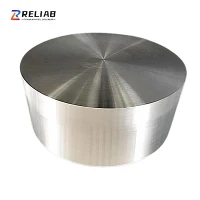
Hey there! As a supplier of TI6AL4V Titanium Round Bars, I often get asked if these bars can be forged. Well, let's dive right into this topic and explore the ins and outs of forging TI6AL4V titanium round bars.
First off, what is TI6AL4V titanium? TI6AL4V, also known as Grade 5 titanium, is one of the most widely used titanium alloys. It's a two - phase (α + β) alloy, with aluminum (Al) and vanadium (V) as its main alloying elements. This alloy offers a great combination of high strength, good corrosion resistance, and excellent weldability. It's used in a variety of industries, from aerospace to medical, due to its outstanding properties.
Now, the big question: Can TI6AL4V titanium round bar be forged? The short answer is yes, it can. But it's not as straightforward as forging some other metals. Forging TI6AL4V requires careful consideration of several factors.
One of the key aspects is the forging temperature. TI6AL4V has a relatively narrow forging temperature range. The ideal forging temperature for this alloy is typically between 925°C and 1040°C (1700°F and 1900°F). If the temperature is too low, the alloy will be too hard and brittle, which can lead to cracking during forging. On the other hand, if the temperature is too high, the grain structure of the titanium can grow too large, which will negatively affect the mechanical properties of the final product.
Another important factor is the forging equipment. You need to use proper forging presses or hammers that can deliver the right amount of force. Since TI6AL4V is a strong alloy, it requires more energy to deform compared to some other metals. Hydraulic presses are often a good choice as they can provide a controlled and consistent force during the forging process.
The forging process itself also has different stages. There's the initial heating stage, where the TI6AL4V round bar is heated to the appropriate forging temperature. Then comes the actual forging, where the bar is shaped into the desired form. After forging, the part needs to be cooled properly. Slow cooling can help in achieving a more uniform microstructure and better mechanical properties.
Let's talk about the benefits of forging TI6AL4V titanium round bars. Forged TI6AL4V parts have improved mechanical properties compared to those made by other manufacturing methods. The forging process aligns the grain structure of the titanium, which results in higher strength and better fatigue resistance. This makes forged TI6AL4V parts ideal for applications where reliability and durability are crucial, such as in aircraft components and high - performance automotive parts.
However, there are also some challenges. As I mentioned earlier, the narrow forging temperature range is a challenge. It requires precise temperature control during the entire forging process. Also, titanium has a tendency to react with oxygen and nitrogen at high temperatures. So, the forging environment needs to be carefully controlled to prevent oxidation and nitriding, which can degrade the properties of the titanium.
If you're in the market for TI6AL4V titanium round bars, you might also be interested in related products. For example, we offer ASTM B348 Titanium Round Bar, which meets specific industry standards. And if you're involved in welding titanium, our TIG Titanium Welding Rod can be a great addition to your toolkit. We also have Ti - 6AL - 7Nb Titanium Bar And Rod, which is another high - quality titanium alloy with its own unique properties.
In conclusion, TI6AL4V titanium round bars can definitely be forged, but it requires a good understanding of the alloy's properties and the forging process. Whether you're a manufacturer looking to use forged TI6AL4V parts in your products or a fabricator interested in working with this alloy, we're here to provide you with the best quality TI6AL4V titanium round bars.


If you're interested in purchasing TI6AL4V titanium round bars or have any questions about forging them, don't hesitate to reach out. We're always happy to have a chat and discuss your specific needs. Let's work together to get the right titanium products for your projects.
References:
- "Titanium: A Technical Guide" by Don Eylon
- Various industry research papers on titanium forging processes