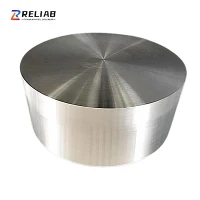
Hey there! I'm a supplier of AMS 4907 Titanium Alloy Sheet. Today, I wanna chat about how the grain structure of AMS 4907 Titanium Alloy Sheet affects its properties.
First off, let's understand what AMS 4907 Titanium Alloy Sheet is. It's a high - performance material widely used in aerospace, medical, and other industries because of its excellent combination of strength, corrosion resistance, and lightweight. But the grain structure of this alloy plays a crucial role in determining its actual performance.
The grain structure of AMS 4907 Titanium Alloy Sheet can be classified into different types, mainly fine - grained and coarse - grained structures. Fine - grained structures are formed when the alloy is processed under certain conditions, like low - temperature deformation and proper heat treatment. Fine grains mean there are more grain boundaries in the material.
One of the most significant impacts of a fine - grained structure is on the strength of the alloy. More grain boundaries act as barriers to the movement of dislocations, which are the main carriers of plastic deformation in metals. When a force is applied to the AMS 4907 sheet, dislocations try to move through the crystal lattice. But the numerous grain boundaries in a fine - grained structure impede their movement, making it harder for the material to deform. As a result, fine - grained AMS 4907 Titanium Alloy Sheet generally has higher yield strength and ultimate tensile strength compared to its coarse - grained counterpart.
For example, in aerospace applications, where components need to withstand high stresses during flight, a fine - grained AMS 4907 sheet can provide the necessary strength. It can handle the forces exerted on aircraft parts such as engine components and structural frames, ensuring the safety and reliability of the aircraft.
Another property affected by the grain structure is ductility. Ductility refers to the ability of a material to deform plastically before fracturing. Coarse - grained AMS 4907 Titanium Alloy Sheet usually has better ductility than fine - grained ones. In a coarse - grained structure, there are fewer grain boundaries, so dislocations can move more freely. This allows the material to undergo larger amounts of plastic deformation without breaking.
In some manufacturing processes, like forming operations where the sheet needs to be bent or stretched into complex shapes, a coarse - grained AMS 4907 sheet might be preferred. For instance, when making medical implants that require a certain degree of flexibility during insertion, the better ductility of a coarse - grained sheet can be an advantage.
The grain structure also has an impact on the corrosion resistance of AMS 4907 Titanium Alloy Sheet. Titanium alloys are known for their good corrosion resistance due to the formation of a passive oxide layer on their surface. However, the grain boundaries can affect the stability of this oxide layer.
In a fine - grained structure, the increased number of grain boundaries provides more sites for the initiation of corrosion. But at the same time, the fine grains can also lead to a more uniform distribution of alloying elements, which can enhance the overall corrosion resistance. On the other hand, coarse - grained structures may have fewer initiation sites, but the distribution of alloying elements might be less uniform, which could potentially lead to localized corrosion in some cases.
Now, let's talk about some of the applications related to the properties influenced by the grain structure. If you're interested in laser cutting of titanium sheet metal, check out this link: Laser Cutting Titanium Sheet Metal. Laser cutting is a common manufacturing process for AMS 4907 Titanium Alloy Sheet. The properties of the sheet, which are affected by the grain structure, can influence the quality of the cut. For example, a fine - grained sheet with higher strength might require more power during laser cutting, but it can also result in a cleaner cut edge.
If you're in need of a 10mm thick AMS 4907 Titanium Alloy Sheet, you can visit this page: 10mm Titanium Plate Sheet. The grain structure of this specific thickness can be optimized according to your application requirements. Whether you need high strength for structural applications or good ductility for forming, we can provide the right grain - structured sheet.
Another interesting product is the Titanium Timascus Plate. The unique pattern of Timascus is created through a process that involves manipulating the grain structure and the alloying elements. The resulting plate not only has an aesthetically pleasing appearance but also retains the excellent properties of AMS 4907 Titanium Alloy.
In conclusion, the grain structure of AMS 4907 Titanium Alloy Sheet has a profound impact on its strength, ductility, and corrosion resistance. Depending on your specific application, you can choose a sheet with the appropriate grain structure. If you're in the market for AMS 4907 Titanium Alloy Sheet and want to discuss your requirements, feel free to reach out. We're here to help you find the best solution for your project.


References
- Callister, W. D., & Rethwisch, D. G. (2011). Materials Science and Engineering: An Introduction. Wiley.
- ASM Handbook Committee. (2000). ASM Handbook Volume 2: Properties and Selection: Nonferrous Alloys and Special - Purpose Materials. ASM International.