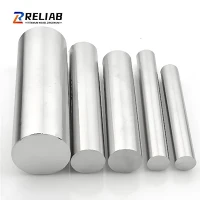
Hey there! As a supplier of ASTM B348 Titanium Round Bars, I often get asked about the electrical conductivity of these bars. So, I thought I'd take a moment to share some insights on this topic.
First off, let's understand what ASTM B348 Titanium Round Bars are. ASTM B348 is a standard specification for wrought titanium and titanium - alloy bars and billets. These bars are widely used in various industries due to their excellent properties like high strength - to - weight ratio, corrosion resistance, and good biocompatibility.
Now, let's talk about electrical conductivity. Electrical conductivity is a measure of a material's ability to conduct an electric current. It's usually expressed in siemens per meter (S/m) or sometimes in percent IACS (International Annealed Copper Standard).
Titanium, in general, is not a great conductor of electricity compared to metals like copper or aluminum. The electrical conductivity of pure titanium is relatively low. For ASTM B348 Titanium Round Bars, the electrical conductivity can vary depending on the specific alloy composition.
Most titanium alloys have electrical conductivities in the range of about 2 - 6% IACS. This is because titanium has a relatively high resistivity. Resistivity is the opposite of conductivity; it's a measure of how much a material resists the flow of electric current.
The reason for the low electrical conductivity of titanium is related to its atomic structure. Titanium atoms have a relatively large number of electrons in their outer shells, and these electrons are not as free to move around as they are in more conductive metals. When an electric field is applied, these electrons don't flow as easily, resulting in lower conductivity.
If you're comparing ASTM B348 Titanium Round Bars with other titanium bars, for example, AMS 4928 Titanium Bar, the electrical conductivity might be similar if they have similar alloy compositions. The AMS 4928 Titanium Bar is also used in many aerospace and high - performance applications, and just like ASTM B348 bars, it has relatively low electrical conductivity.
Another type of titanium bar is the BT1 - 0 Pure Titanium Bar. Pure titanium bars generally have a slightly different electrical conductivity profile compared to alloyed bars. Since they don't have the additional alloying elements, their conductivity might be a bit different, but still in the relatively low range typical of titanium.
The Gr16 Ti - 0.05Pd Titanium Bar is an alloy with palladium added. The addition of palladium can have an impact on the electrical conductivity. Palladium is a better conductor than titanium, but the overall conductivity of the Gr16 bar still remains in the lower range compared to highly conductive metals.
So, why is the electrical conductivity of ASTM B348 Titanium Round Bars important? Well, in some applications where electrical conductivity is a critical factor, this low conductivity can be a drawback. For example, in electrical wiring applications, materials with high conductivity like copper are preferred. However, in other applications, the low conductivity can be an advantage. For instance, in applications where electrical insulation or resistance to electrical interference is required, titanium bars can be a great choice.
In industries such as aerospace, where weight is a major concern, the high strength - to - weight ratio of ASTM B348 Titanium Round Bars outweighs the relatively low electrical conductivity. These bars are used in structural components, engine parts, and other areas where mechanical properties are more important than electrical conductivity.
If you're in the market for ASTM B348 Titanium Round Bars, it's important to understand your specific requirements. If electrical conductivity is a key factor for your application, you might need to consider alternative materials or work with us to find the best solution. We can provide you with detailed information about the electrical conductivity of our bars, as well as other properties like mechanical strength, corrosion resistance, and more.
We have a wide range of ASTM B348 Titanium Round Bars in different sizes and specifications. Whether you need small - diameter bars for precision applications or large - diameter bars for heavy - duty projects, we've got you covered. Our bars are manufactured to the highest quality standards, ensuring that you get a product that meets your needs.
If you're interested in learning more about our ASTM B348 Titanium Round Bars or have any questions about their electrical conductivity or other properties, don't hesitate to reach out. We're here to help you make the right choice for your project.


In conclusion, the electrical conductivity of ASTM B348 Titanium Round Bars is relatively low compared to some other metals, but this can be both a drawback and an advantage depending on the application. If you think our bars might be a good fit for your project, let's start a conversation. We're ready to discuss your requirements and provide you with the best possible solution.
References:
- ASTM International. ASTM B348 - Standard Specification for Wrought Titanium and Titanium - Alloy Bars and Billets.
- Various industry reports on titanium properties and applications.