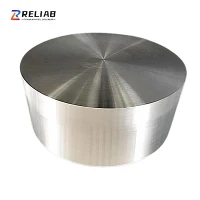
As a supplier of AMS 4928 Titanium Bar, understanding the forging temperature range is crucial for producing high - quality products. In this blog, I will delve into the details of the forging temperature range for AMS 4928 Titanium Bar, explaining its significance, influencing factors, and the optimal range based on industry standards and practical experience.
Significance of Forging Temperature Range
Forging is a critical process in the manufacturing of AMS 4928 Titanium Bar. The right forging temperature range ensures that the titanium bar can achieve the desired mechanical properties, such as strength, ductility, and toughness. If the forging temperature is too high, the titanium may experience grain growth, which can lead to a reduction in mechanical properties and an increase in the risk of cracking during subsequent processing or use. On the other hand, if the forging temperature is too low, the titanium may not deform properly, resulting in internal stresses, poor surface finish, and potential for incomplete forging.
Factors Influencing the Forging Temperature Range
Several factors influence the forging temperature range of AMS 4928 Titanium Bar.
Alloy Composition
AMS 4928 Titanium Bar is an alloy, and its composition plays a vital role in determining the forging temperature. The presence of different alloying elements can change the phase transformation temperatures of titanium. For example, some alloying elements may lower the beta - transus temperature, which is the temperature at which the titanium changes from the alpha phase to the beta phase. This shift in the beta - transus temperature directly affects the forging temperature range.


Forging Process
The type of forging process also impacts the forging temperature. Open - die forging, closed - die forging, and upset forging each have different requirements for temperature. Open - die forging, which allows for more freedom in shaping the titanium bar, may require a slightly different temperature range compared to closed - die forging, where the material is confined within a die cavity. Upset forging, which involves increasing the cross - sectional area of the bar, also has its own unique temperature requirements.
Desired Mechanical Properties
The end - use application of the AMS 4928 Titanium Bar dictates the desired mechanical properties. For applications that require high strength, the forging temperature may be adjusted to promote a fine - grained microstructure. In contrast, applications that demand high ductility may require a different forging temperature to achieve a coarser - grained structure.
Determining the Forging Temperature Range
The forging temperature range for AMS 4928 Titanium Bar typically depends on the beta - transus temperature of the alloy. The beta - transus temperature for AMS 4928 is usually in the range of 920 - 940°C (1688 - 1724°F).
Alpha - Beta Forging
Alpha - beta forging is commonly used for AMS 4928 Titanium Bar. In this process, the forging is carried out in the temperature range below the beta - transus temperature. A typical alpha - beta forging temperature range for AMS 4928 is 815 - 920°C (1500 - 1688°F). Forging in this range helps to maintain a fine - grained alpha - beta microstructure, which provides a good balance of strength and ductility.
Beta Forging
Beta forging, on the other hand, is performed above the beta - transus temperature. The temperature range for beta forging of AMS 4928 Titanium Bar is usually 940 - 1010°C (1724 - 1850°F). Beta forging can result in a coarser - grained beta microstructure, which may be suitable for applications that require high fracture toughness.
Practical Considerations in Forging
When forging AMS 4928 Titanium Bar, it is essential to control the forging temperature accurately. This can be achieved through the use of temperature - measuring devices such as thermocouples. Pre - heating the dies is also important to prevent rapid cooling of the titanium bar during forging. Additionally, the forging speed and the amount of deformation per pass should be carefully controlled to ensure uniform deformation and avoid cracking.
Our Offerings as a Supplier
As a supplier of AMS 4928 Titanium Bar, we have extensive experience in forging this alloy. We use state - of - the - art equipment and strict quality control measures to ensure that our AMS 4928 Titanium Bars are forged within the optimal temperature range. Our products are suitable for a wide range of applications, including aerospace, automotive, and medical industries.
In addition to AMS 4928 Titanium Bar, we also offer other related products such as TIG Titanium Welding Rod and Grade 7 Titanium Solid Round Bar. These products are manufactured with the same high - quality standards and can be used in conjunction with our AMS 4928 Titanium Bar.
Contact Us for Procurement
If you are interested in purchasing AMS 4928 Titanium Bar or any of our other titanium products, we encourage you to contact us for procurement. Our team of experts is ready to assist you with any questions you may have regarding the forging process, product specifications, or pricing. We are committed to providing you with the best - quality products and excellent customer service.
References
- "Titanium Alloys: Fundamentals and Applications" by E. W. Collings and U. Anselmi - Tamburini.
- "Metal Forming: Processes and Analysis" by Dieter, G. E.
- Aerospace Material Specification (AMS) 4928 documentation.