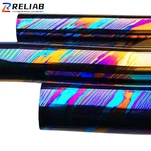
Among numerous metal processing techniques, titanium alloy anodizing has attracted much attention due to its unique color-changing effect. This color change is not achieved through traditional coating methods, but rather based on a special surface modification principle, which allows titanium alloys to exhibit a rich variety of colors.
The principle of anodizing color change: surface modification rather than coating. The core of titanium alloy anodizing lies in generating a controllable thickness oxide film on the metal surface, the main component of which is TiO₂. This is fundamentally different from processes such as painting and electroplating, which attach an external coating to the metal surface, while anodizing is a surface modification of the metal itself.
The color presentation originates from the "light interference effect" of the oxide film. TiO₂ films of different thicknesses reflect and refract visible light to varying degrees, thus producing a variety of colors. For example, when the film thickness is between 50 and 80 nm, the titanium alloy appears blue; when the film thickness is between 100 and 120 nm, it appears golden. This oxide film achieves atomic-level bonding with the titanium alloy substrate.
Since the oxide film is formed by the direct oxidation of the base metal, there is no obvious interface between the two, and it is not a simple adhesion relationship. Therefore, the problem of "coating peeling and discoloration" is fundamentally avoided, which is the core advantage of anodizing compared to processes such as painting and electroplating.
Factors that may cause color changes rather than fading:
Although anodizing titanium alloys does not result in overall color fading, the color can still change when the integrity, thickness, or surface condition of the oxide film is compromised. Here are some common influencing factors:
Mechanical wear:
Thinning or localized damage to the oxide film leads to color change. The thickness of the anodic oxide film on titanium alloys is typically between 50 and 200 nm, which is extremely thin, about 1/500th the diameter of a human hair. Moreover, the hardness of the oxide film is lower than that of the titanium alloy substrate, ranging from HV 300 to 500, while the hardness of the titanium alloy substrate is approximately HV 350 to 500, with some alloys having even higher hardness.
Chemical corrosion:
The oxide film is eroded, resulting in a darker color or the appearance of spots. Although the TiO₂ oxide film has a certain degree of corrosion resistance, it is not absolutely resistant to all media. When titanium alloys come into contact with highly corrosive environments, the oxide film may be eroded.
High-temperature environments:
Changes in oxide film thickness or structure lead to color shifts. The stability of TiO₂ oxide films is significantly affected by temperature. When the temperature exceeds 300℃, the oxide film may further oxidize and thicken, or its crystal structure may transform from the anatase phase to the rutile phase, resulting in a color shift. For example, the original blue may deepen to a bluish-black.
The color-changing effect achieved by anodizing titanium alloys is unique. While it doesn't experience the traditional "fading," its color stability is affected by factors such as mechanical wear, chemical corrosion, and high-temperature environments. In practical applications, we need to fully consider these factors and take appropriate protective measures based on the specific scenario to ensure that the color of the anodized titanium alloy remains stable over the long term.


Baoji Reliab Metal Materials Co.,Ltd
Mobile: 0086 13092900605
Sales Department 1: WhatsApp +8613092900605 (Mr.Gary)
Sales Department 2: +8613092913521(Ms. Sophia)
Address: No.35 Baoti Rd, Weibin District, Baoji, China