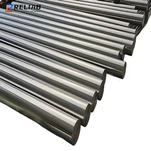
Titanium bar straightening is a crucial process that uses external force to induce controlled plastic deformation in bent titanium bars, eliminating defects such as bending and waviness, and ensuring straightness and dimensional accuracy. The process revolves around two main approaches: cold straightening and hot straightening, adapted to different specifications and alloy states. Strict control of residual stress and surface quality is also essential. The following provides a detailed introduction covering core methods, process essentials, key parameters, quality control, and common problems.
I. Mainstream alignment methods and their applicable scenarios
A.Pressure straightening: Single-point or multi-point pressure application induces reverse plastic deformation at the bend, counteracting the original curvature. Large-diameter, highly curved titanium rods, such as rough forged rods. Pressure straightening machine, hydraulic press.
B. Roller straightening (oblique roller / sinusoidal): Multi-roll (5-29 rolls) continuous three-point bending is used to gradually reduce residual curvature, and a sinusoidal straightening algorithm is employed to optimize the roll positions. Small and medium-diameter titanium rods, mass production. Diagonal roll straightening machine.
C. Tension straightening: Applying a longitudinal tensile force exceeding the yield strength ensures uniform plastic elongation in each section, thereby counteracting the wave-like defects. Small-diameter, wavy-shaped titanium rods with defects. Tension leveling machine.
D. Hot straightening (including thermal tensioning): Heat the material to the plastic deformation range below the β phase transition point (e.g., approximately 750℃ for Gr5), then apply pressure/tension for straightening, and finally cool and solidify. High-strength titanium alloy, small-diameter, easily breakable rods. Tension/compression testing machine with heating device.
II. Key Process Points
Pre-processing and Clamping
Clean the surface of oil and scale to avoid indentation or stress concentration; large-diameter bars require pre-straightening (pressure straightening) to reduce curvature, facilitating subsequent roller/tension straightening.
Ensure uniform clamping force during clamping to prevent slippage or end face damage; high-temperature straightening requires high-temperature resistant fixtures to prevent clamping failure at high temperatures.
Parameter Matching Principles
Roller straightening: Smaller roller diameter and more rollers result in higher accuracy; roller spacing should be adapted to the bar diameter, the roller angle decreases with increasing bar diameter, and the pressure is positively correlated with yield strength and curvature.
Tension straightening: The stretching amount is controlled at 0.5%-2% (up to 2% in the hot state), avoiding overstretching that leads to diameter deviations.
Thermal straightening: The temperature is controlled at 50-100℃ below the phase transition point (e.g., 750℃ for Gr5), held for 10-30s, followed by rapid straightening and air cooling or slow cooling.
Cooling and Post-processing
After cold straightening, natural aging can be used to eliminate residual stress; after hot straightening, air cooling is preferred to avoid uneven structure or deformation rebound caused by water cooling.
If necessary, stress relief annealing (e.g., 500-600℃, holding for 30-60min) is added to reduce residual stress to ≤150MPa.
III. Quality Control and Testing Standards
Straightness: Medical grade titanium rods ≤1mm/m, aerospace grade ≤0.5mm/m, industrial grade ≤3mm/m; tested using a straightedge, dial indicator, or laser straightness measuring instrument.
Surface Quality: No indentations, cracks, or peeling; surface roughness Ra≤1.6μm; surface defects are inspected visually and with eddy current testing.
Residual Stress: Tested using X-ray diffraction, controlled to ≤150MPa to prevent deformation during subsequent processing or cracking during service.
Dimensional Accuracy: Diameter tolerance ±0.05-±0.1mm (depending on application), ovality ≤0.1mm.


Baoji Reliab Metal Materials Co.,Ltd
Mobile: 0086 13092900605
Sales Department 1: WhatsApp +8613092900605 (Mr.Gary)
Sales Department 2: +8613092913521(Ms. Sophia)
Address: No.35 Baoti Rd, Weibin District, Baoji, China