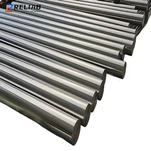
Titanium , a transition metal element in the fourth group of the fourth period of the periodic table (Titanium subgroup), has the element symbol Ti, atomic number 22, and a relative atomic mass of 47.867. Titanium is a hard, lustrous, silvery-white metal with hexagonal α phase and cubic β phase. The relative density is 4.506, the melting point is 1668℃, and the boiling point is 3287℃. Resistivity: 42 × 10-8Ω·m (at 20℃). In nature, it mainly exists in the form of rutile, perovskite, ilmenite, etc. At high temperatures, titanium tetrachloride is reduced by magnesium to obtain sponge titanium, which is then melted by the arc method to obtain titanium ingots.
Titanium is widely distributed in nature. It ranks seventh in terms of the content of metallic elements, only after aluminium, iron, calcium, potassium, sodium and magnesium. Titanium mainly exists in minerals in the forms of titanium dioxide, titanates and titanosilicates.
Titanium has extremely excellent properties and thus has been widely applied. Its main application fields include: aerospace, shipbuilding, chemical engineering and petrochemicals, transportation, weaponry, Marine, power, construction, metallurgy, medical care, sports equipment, daily necessities and light industry, etc.
Titanium has an atomic number of 22 and a total of 22 electrons outside its nucleus. Its electronic configuration is 1s22s22p63s23p63d24s2 ([Ar]3d24s2). Titanium has two allotropes: α-Ti and β-Ti. The density of α-Ti is 4.506g/cm ³, while that of β-Ti at 900℃ is 4.400g/cm ³. α-Ti belongs to the hexagonal crystal system, with atomic packing in a hexagonal close-packed manner and an atomic space utilization rate of 74%. β-Ti is a cubic lattice, with atomic packing in a body-centered cubic close-packed manner, and the atomic space utilization rate is 68%. In addition, when a small amount of defects occur in titanium crystals, it will affect the properties of the crystals, such as mechanical strength and electrical conductivity
Titanium is malleable. The elongation of high-purity titanium can reach 50-60%, and the reduction of area can reach 70-80%. However, it has low strength and is not suitable for use as a structural material. The presence of impurities in titanium has a significant impact on its mechanical properties, especially interstitial impurities (oxygen, nitrogen, carbon), which can greatly enhance the strength of titanium and significantly reduce its plasticity. The excellent mechanical properties of titanium as a structural material are achieved by strictly controlling the appropriate impurity content and adding alloying elements. Titanium is a silvery-white malleable metal. It has great industrial significance because it possesses many valuable properties. It is less specific gravity than iron, has a much higher strength than aluminium, and its corrosion resistance is similar to that of platinum. These properties make it an ideal material for building engines, aircraft frames, missiles, Marine facilities, etc. For these materials, they require excellent properties such as light weight, high strength, and resistance to extreme temperature changes, and titanium is unrivaled in these aspects. Some properties of titanium, such as tensile strength, are enhanced by the ability to form alloys with aluminium. In addition, the α-β transition temperature of aluminum-titanium alloys is higher than that of pure titanium. Titanium can also form useful alloys with molybdenum, manganese, iron and other metals.
Baoji Reliab Metal Materials Co.,Ltd
Tel: +86-917-8883215
Mobile: +8613092900605
+8613092913521
E-mail: garychen3215@hotmail.com