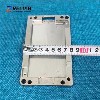
A 60-millimeter-long titanium alloy tensile test specimen-not forged, but laser-printed layer by layer. Test results showed a yield strength of 1,501 MPa, a tensile strength of 1,726 MPa, and a uniform elongation of 7.5%. In contrast, Ti-6Al-4V-a titanium alloy commonly used in aerospace applications and printed using the same process-achieved only about 60 percent of this tensile strength. These findings were published in *Nature Materials* by the team led by Jian Lu at City University of Hong Kong.
Nanometals are very strong, but they can't be made into large components. There's a well-established principle in materials science: the finer the grain size, the harder the metal. However, nanostructures could previously only be produced through processes such as coating or severe deformation, resulting in thin films or small samples-not strong enough to support aircraft parts. 3D printing naturally involves rapid cooling: the melt pool cools at a rate of 100,000 to 10 million degrees Celsius per second, making it an ideal "furnace" for "freezing" nanostructures into large metal blocks. The problem is that there are tens of thousands of possible combinations of element ratios and laser parameters-testing them one by one would take an eternity.
Moreover, chromium presents a bit of a dilemma: while it can stabilize titanium's high-temperature phases and serves as a readily available strengthening agent, it tends to segregate and agglomerate in traditional casting processes, so no one has ever fully mastered its use in titanium. 3D printing bypasses the ingot casting process, effectively overcoming this hurdle.
The team's approach consisted of two steps. First, they used a laser powder bed to produce small test specimens with 118 different combinations of Ti-Al-Cr ratios, power levels, and scanning speeds. These were then subjected to standardized tensile testing to compile a clean dataset. Next, they trained an XGBoost model on this dataset: the prediction error for strength was less than 50 megapascals, and most predicted values fell within ±5% of the measured values. The model was then instructed to rank the top 5% of 38,052 virtual combinations, and only this small subset was validated-which is how the optimal formulation, Ti-7.5Al-3.3Cr, was identified. The model also conveniently identified the key contributing factor: chromium content was the variable with the greatest impact on strength.
The printed microstructure resembles a set of matryoshka dolls: 99.1% of the alloy is martensite, with lamellae approximately 75 nanometers thick; inside these lamellae are "stacked nanobands" less than 10 nanometers thick-the crystals form a mille-feuille-like structure, with three stacking patterns (AB, BC, and CA) alternating at an interlayer period of about 6 nanometers. This mille-feuille structure is the "signature" of rapid cooling.
The team reheated the alloy to 1,000°C and compared different cooling methods: furnace cooling, air cooling, and water quenching all failed to restore the original structure. Only the printing method-with a cooling rate exceeding 100,000 degrees per second-could freeze the layered structure in its original form. During deformation, dislocations-linear defects in metals responsible for slip-are cut into segments less than 10 nanometers long when they encounter the nanostrips, making it nearly impossible for them to move forward. Molecular dynamics simulations captured the details: to cross the stacking interface, dislocations must first split into two halves, a process that requires additional energy. As a result, the material is both hard and capable of sustained hardening: the peak work-hardening rate reaches 6.5 gigapascals, and it remains unbroken and without necking even when stretched to 7.5% strain.
More ductile? Increasing the chromium content from 3.3 to 5 raises the elongation to 12.4% and the strength to 1,555 MPa; increasing it to 7.5 yields an elongation of 15.9% and a strength of 1,449 MPa-an adjustable strength-ductility trade-off. Converted to specific strength-380 MPa·cm³ per gram-it outperforms as-printed steel, aluminum alloys, nickel alloys, and high-entropy alloys.

 E-mail: garychen3215@hotmail.com
 Address: No.35, Baoti Rd, Baoji city, Shaanxi Province, China
 Contact: Mr. Gary Chen
 Phone: +86-917-8883215
 Mobile/WhatsApp: +86 13092900605