Research on titanium alloys in China began in the 1950s, initially focusing on the aerospace sector. Following years of independent research and development, titanium alloys have been successfully applied across various fields, including aerospace, marine engineering, medical devices, the automotive industry, and petrochemicals. This paper briefly outlines three common vacuum melting processes for titanium alloys.
Titanium alloys exhibit extremely high chemical reactivity at elevated temperatures, capable of reacting with almost all refractory materials as well as gases such as H₂, N₂, and O₂; consequently, melting must be conducted in water-cooled crucibles under a vacuum or an inert gas atmosphere. Common industrial methods for melting titanium alloys include vacuum consumable arc melting, electron beam cold-hearth melting, and vacuum induction melting.
01 PART
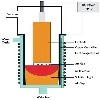
Vacuum Arc Remelting (VAR) is currently the most mature and widely used industrial melting process for titanium alloys. The melting principle of a vacuum arc remelting furnace is illustrated in Figure 1. The VAR process enables the efficient removal of gases (such as H₂ and N₂) and volatile impurities in a high-vacuum environment, thereby enhancing melt cleanliness and significantly reducing microstructural segregation. Key advantages of the VAR process include rapid melting rates and ease of equipment operation, making it suitable for producing large-sized titanium alloy ingots. However, the process has limitations regarding the control of arc distribution and casting temperature; improper selection of process parameters can easily lead to quality issues, particularly the formation of high-density inclusions.
02 PART
Electron Beam Cold Hearth Melting (EBCHM) is a novel melting method developed during the 1970s and 1980s and represents a cutting-edge technology in the field of metallurgy. This process involves melting metallic materials in a high-vacuum environment by converting the kinetic energy of a high-speed electron beam into thermal energy; the melting principle is illustrated in Figure 2. EBCHM offers numerous advantages, including controllable temperature and melting rates, superior impurity removal capabilities, the production of high-quality titanium alloys in diverse specifications, a streamlined process flow, and environmental cleanliness.
03 PART
Vacuum Induction Levitation Melting - Vacuum induction levitation melting is a novel, advanced metal melting process. It achieves the melting and stirring of metal within a vacuum or inert gas environment via electromagnetic induction, utilizing the levitation force generated by the coil to suspend the molten metal. Compared to traditional melting methods, this process eliminates direct contact between the melt and the crucible, thereby reducing impurity contamination; simultaneously, the electromagnetic stirring action ensures thorough mixing of the molten metal, effectively minimizing compositional segregation.

 E-mail: garychen3215@hotmail.com
 Address: No.35, Baoti Rd, Baoji city, Shaanxi Province, China
 Contact: Mr. Gary Chen
 Phone: +86-917-8883215
 Mobile/WhatsApp: +86 13092900605