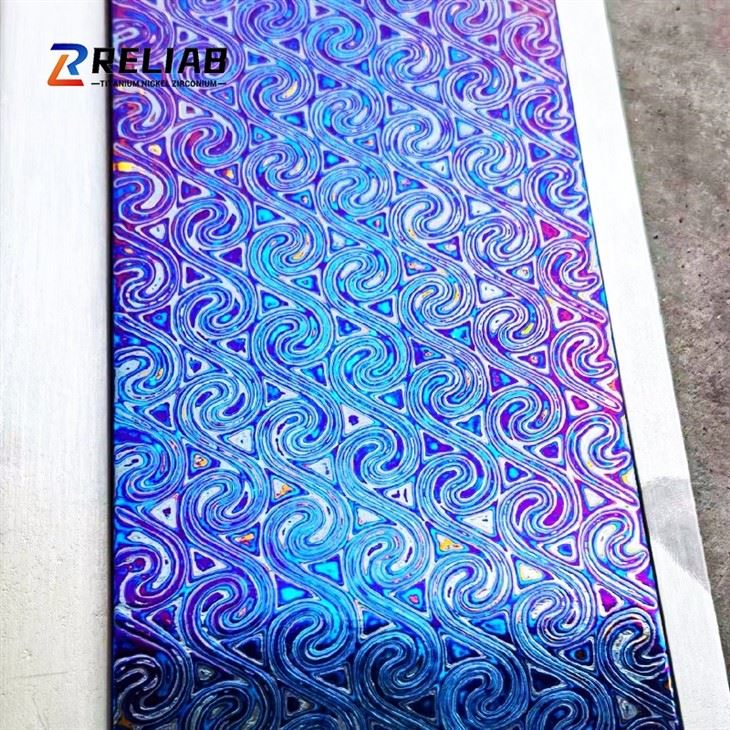
Titanium Damascus plates are specialized titanium plates featuring natural, layered patterns. They are produced using Grade 2 (GR2) pure titanium or Grade 5 (GR5) titanium alloy as the base material, processed through vacuum diffusion bonding, torsional forging, and rolling. Throughout the entire procedure, the material is kept isolated from oxygen to prevent oxidation and delamination. The complete process is as follows:
I. Raw Material Selection and Pre-processing
Substrate Selection: High-purity TA2 titanium plates and TC4 titanium alloy plates are selected. Material composition is verified, and any blanks containing oxide scale, sand holes, or cracks are discarded.
Cutting and Layering: Titanium sheets of varying thicknesses are cut according to a specific ratio and stacked in an alternating pattern to form a multi-layered composite blank.
Deep Cleaning and Degreasing: The process includes alkaline cleaning to remove oils, acid pickling to eliminate surface oxide layers, rinsing with purified water, and high-temperature drying. This ensures the plate surfaces are free of impurities and water stains, preventing the formation of pores or delamination during high-temperature bonding.
II. Vacuum Encapsulation (Critical Anti-Oxidation Step)
The stacked titanium sheets are neatly arranged and fully enclosed within a thin, pure-titanium outer sheath, which is then welded shut under an argon gas shield. The assembly is subsequently vacuum-sealed to isolate it from the atmosphere, preventing the titanium from reacting with oxygen or nitrogen at high forging temperatures-a reaction that would otherwise create a brittle oxide layer.
III. High-Temperature Vacuum Diffusion Bonding
The sealed blank is placed into a heating furnace and brought to the diffusion temperature of titanium, where it is held under constant temperature and pressure. At the contact interfaces, atoms from the various titanium layers diffuse into one another, creating a metallurgical bond that ensures the material will not delaminate or peel during subsequent processing.
IV. Torsion Forging (Creating the Unique Damascus Pattern)
After being removed from the furnace at high temperature, the composite blank is forged into a uniform square billet.
The billet is reheated, and its ends are twisted in opposite directions. This causes the multiple layers of titanium to intertwine, creating a complex, interlaced internal grain structure.
Through repeated cycles of reheating, forging, and further twisting, the depth and complexity of the pattern are enhanced, allowing for precise control over the density and distribution of the visible grain. V. Hot/Cold Rolling and Sheet Forming
Rough Rolling: Repeated rolling reduces the thickness of the forged billet, transforming it into a semi-finished thick plate while releasing internal stress.
Intermediate Annealing: Eliminates internal stress generated during rolling, preventing the formation of latent micro-cracks within the material.
Finish Rolling: Precision rolling to the thickness specified by the client, resulting in a "Timascus" (titanium damascus) substrate of the required standard thickness.
VI. Leveling and Stress-Relief Annealing
Since the sheets are prone to warping or deformation after rolling, they undergo mechanical leveling to ensure flatness. This is followed by low-temperature stress-relief annealing to stabilize the material's properties, preventing cracking during subsequent cutting or bending processes.
VII. Rough Grinding and Non-Destructive Testing (NDT)
Rough Grinding: Removes surface oxide scale and traces from encapsulation welds, revealing the distinct, layered patterns.
Non-Destructive Testing: Ultrasonic testing is used to detect internal delamination, latent cracks, or porosity; any defective billets are discarded.
VIII. Precision Grinding and Polishing (Customized to Requirements)
Processing options vary based on the intended application:
Industrial-Grade Billets: Precision-ground on one or both sides to achieve a smooth, matte finish, facilitating further machining or engraving by the client.
Jewelry/EDC-Grade Billets: Mirror-polished to highlight the three-dimensional, distinct patterns; these are ready for direct anodizing or heat-coloring.
IX. Cutting, Slitting, Protective Film Application, and Warehousing
Sheets are precision-cut to the client's specified dimensions, with waste material (edges lacking patterns) removed. The surfaces are cleaned, covered with a protective film, categorized, stored, and packed for shipment.

Contact Us
High Quality+Competetive Pricing+Fast Delivery+No MOQ