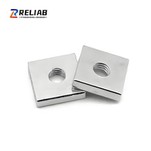
Titanium alloys are high-performance materials for manufacturing bolts, especially suitable for applications with stringent requirements for weight, corrosion resistance, and extreme environments; however, their high cost and processing complexity must be weighed against. In general industrial applications, stainless steel or high-strength steel remain more economical choices.
Core Advantages
High Strength and Lightweight Balance
Titanium alloys (such as Ti-6Al-4V) boast tensile strengths of 900-1200 MPa and a density only 60% that of steel (approximately 4.5 g/cm³), allowing for a 30%-40% weight reduction in bolts and lowering the overall load after assembly. This is particularly suitable for weight-sensitive applications such as aerospace and racing.
Their specific strength (strength/density) far exceeds that of stainless steel and aluminum alloys, resulting in smaller dimensions for the same load-bearing capacity.
Excellent Corrosion Resistance
The surface oxide film (TiO₂) withstands seawater, acidic and alkaline environments, and high-temperature oxidation, extending their service life by 3-5 times compared to steel bolts in shipbuilding, chemical equipment, and marine engineering.
Avoids the electrochemical corrosion risks associated with traditional steel bolts, reducing maintenance costs.
Low-temperature and high-temperature stability: It maintains good toughness at low temperatures (-200°C) with no risk of brittle fracture, making it suitable for polar scientific research equipment; at high temperatures (300-500°C), its strength decay rate is lower than that of aluminum alloys, making it suitable for engine peripheral components.
Suitable Scenarios
Ideally suited for:
- Aerospace: Aircraft fuselage and engine compartment fasteners (e.g., the Boeing 787 extensively uses titanium alloy fasteners)
- Marine Engineering: Bolts for ships, offshore platforms, and desalination equipment
- Chemical Equipment: Flange connections in highly corrosive environments
- Medical Devices: Orthopedic implant screws (excellent biocompatibility)
- Racing/High-Performance Vehicles: Parts sensitive to every gram of weight
Technical Improvement Directions
Coating Technology: Utilizing PVD titanium nitride (TiN) coatings reduces the coefficient of friction to 0.3-0.4, improving wear resistance.
Composite Strengthening: Through β heat treatment + cold rolling of threads, fatigue strength is increased by 20%-30%.
Near-Net-Shape Forming: Powder metallurgy titanium alloy bolts can reduce material waste by more than 50%, lowering manufacturing costs.


 E-mail: garychen3215@hotmail.com
 Address: No.35, Baoti Rd, Baoji city, Shaanxi Province, China
 Contact: Mr. Gary Chen
 Phone: +86-917-8883215
 Mobile/WhatsApp: +86 13092900605