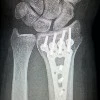
When you or a family member needs a joint replacement, dental implant, or bone plate, your doctor will most likely mention one word: titanium alloy. This silvery-white metal, often referred to as the "space metal," has not only reached for the moon but has also quietly found its way into the bodies of countless people, becoming the "gold standard" for orthopedic and dental implants. But what exactly makes it so special? Today, let's explore the secret behind how titanium alloy "coexists peacefully" with the human body.
The key reason titanium alloys have become the material of choice for implants can be summed up in one phrase: they are sufficiently "inert."
Here, "low-maintenance" is meant as a compliment. Titanium readily forms a dense oxide layer (titanium dioxide, TiO₂) when exposed to air. This layer is extremely stable and is resistant to corrosion even in the body's fluid environment, which contains chloride ions and experiences fluctuations in pH. This means that, unlike certain metals, titanium implants do not slowly release harmful ions within the body, causing inflammation or toxic reactions. More importantly, this oxide layer prevents human tissues from "recognizing" it as a foreign object. When a titanium implant is placed in bone tissue, osteoblasts not only do not reject it but actively adhere to and grow around it, ultimately forming a direct physical bond with the titanium surface. This process is called osseointegration, and it is the fundamental reason dental implants can stably withstand chewing forces.
If the goal is simply to "stay out of trouble," stainless steel can do that too. What makes titanium truly remarkable is how well its mechanical properties match those of bone.
Bone is a smart, living tissue: it requires continuous mechanical stimulation to maintain its density. If an implant is too "stiff," it will "take over" the forces that should be borne by the bone, causing the surrounding bone tissue to gradually atrophy due to the "use it or lose it" principle-this is known as the stress shielding effect. The moduli of elasticity for stainless steel and cobalt-chromium-molybdenum alloys are approximately 200 GPa and 220 GPa, respectively, which are far higher than that of human bone (approximately 20 GPa). The modulus of elasticity for titanium alloys can reach around 100 GPa, while new β-titanium alloys can even be as low as 57–68 GPa, bringing them closer to the "hardness" of natural bone. This means that when titanium implants bear weight, they can more naturally transmit mechanical stimulation to the surrounding bone tissue, reducing the risk of bone resorption.
An often-overlooked advantage: MRI compatibility. Anyone who has undergone an MRI knows that metal implants in the body can often cause problems. However, titanium alloys are quite "unobtrusive" in this regard.
Titanium has an extremely low magnetic susceptibility-far lower than that of stainless steel and cobalt-chromium alloys-resulting in minimal artifacts during MRI scans and a low risk of displacement or overheating. A science popularization article from West China Stomatological Hospital clearly states that patients with titanium dental implants can safely undergo CT and MRI scans. This is crucial for orthopedic and dental patients who require long-term follow-up.
Since its first use in orthopedics in the 1950s, titanium alloy has been in use for more than 70 years. Every year, more than 1,000 metric tons of titanium medical devices are implanted into the human body worldwide. It is not perfect, but in an almost "understated" way, it bears weight, moves, and chews within the body's most challenging environment, quietly supporting the lives of countless people.

 E-mail: garychen3215@hotmail.com
 Address: No.35, Baoti Rd, Baoji city, Shaanxi Province, China
 Contact: Mr. Gary Chen
 Phone: +86-917-8883215
 Mobile/WhatsApp: +86 13092900605