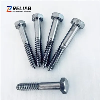
When it comes to titanium alloy screws, many people's first thought is, "This is an ultra-high-strength material."
In fact, this is a common misconception. Titanium alloys are not inherently materials of exceptionally high strength; their tensile strength is roughly equivalent to that of high-quality alloy structural steels (such as 45 steel), and while some grades may be slightly higher, they do not reach the level of being "far superior to steel." So, what exactly is the core advantage of titanium screws? The answer is-specific strength.
What is specific strength? Specific strength = strength ÷ density. It measures how much load a material can withstand for a given weight. · The density of titanium alloy is approximately 4.51 g/cm³, which is only 50% to 60% of that of 45 steel (approximately 7.85 g/cm³). · The strength of titanium alloys is roughly equivalent to that of 45 steel (titanium alloys are slightly higher). Therefore, while titanium screws and steel screws of the same volume have similar strength, a titanium screw of the same weight has approximately twice the strength of a steel screw. In other words, when you need a screw that can withstand a specific load while minimizing weight as much as possible, a titanium screw is an excellent choice.
The Family and Composition of Titanium Alloys Titanium alloys are not a single material, but rather a family of alloys based on titanium with added elements such as aluminum, copper, manganese, and vanadium. Common grades include Gr5 (Ti-6Al-4V) and Gr2, and there are over 70 types of titanium alloys in the industry. By adjusting the alloy composition, titanium materials with different properties can be produced to meet the demands of various operating conditions.


Typical Applications: Scenarios Requiring Both Lightweight and High Strength The advantages of titanium screws are particularly evident in fields that demand both strength and low weight. The most typical example is the aerospace industry: · Titanium alloys are widely used in aircraft engine components, airframes, skins, landing gear, and a large number of fasteners (including screws). · Weight reduction translates to lower fuel consumption, higher payloads, and longer flight ranges. Additionally, in high-end automotive modifications, competitive bicycles, medical devices, and marine engineering, titanium screws are highly favored for their corrosion resistance, non-magnetic properties, light weight, and reliable strength.
Summary: How to Choose the Right Titanium Screws?
· If you require absolute high strength (such as withstanding tensile forces far exceeding those of steel screws), titanium screws may not necessarily be superior to special alloy steel.
· If you need to significantly reduce weight while ensuring sufficient strength, or require additional properties such as corrosion resistance or non-magnetic properties, then titanium screws are the ideal choice. Understanding "specific strength" rather than "absolute strength" is key to fully leveraging the unique value of titanium screws.
 E-mail: garychen3215@hotmail.com
 Address: No.35, Baoti Rd, Baoji city, Shaanxi Province, China
 Contact: Mr. Gary Chen
 Phone: +86-917-8883215
 Mobile/WhatsApp: +86 13092900605