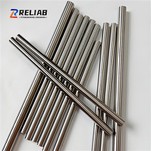
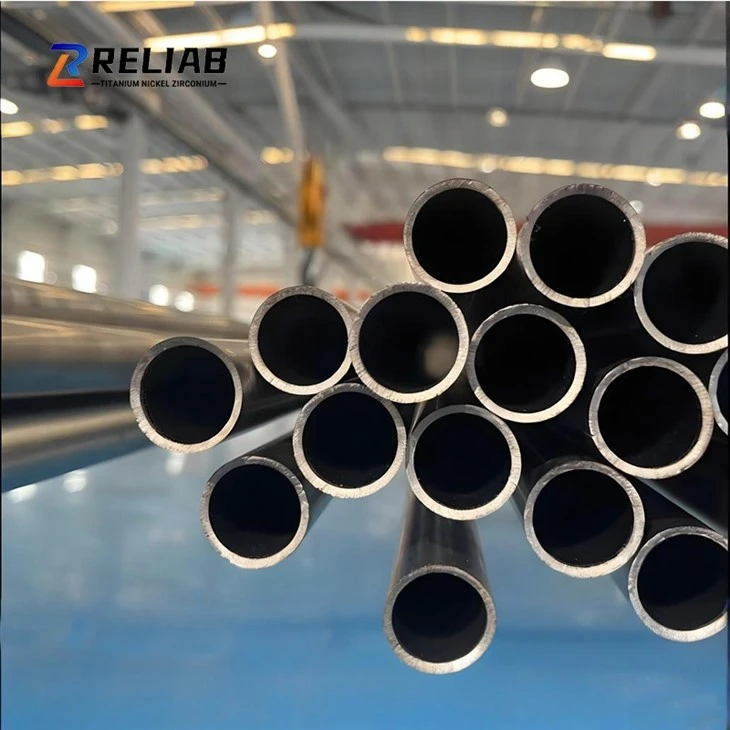
The key differences between GR9 and GR5 titanium tubes lie in their alloy composition, strength grade, and formability. GR5 (Ti-6Al-4V) is widely recognized as the "flagship" high-strength titanium alloy; it offers extremely high strength but is difficult to cold-form; GR9 (Ti-3Al-2.5V), on the other hand, is a "compromise" option; although its strength is lower than that of GR5, its ductility, cold workability, and weldability are far superior to those of GR5, making it an ideal material for manufacturing seamless tubes, particularly aerospace hydraulic tubes.
The following is a detailed comparative analysis based on industry standards and material properties:
1. Chemical Composition and Alloy Systems
Both are α+β dual-phase titanium alloys, but their alloying element contents differ significantly.
GR5 (Ti-6Al-4V): Contains high levels of aluminum (5.5–6.75%) and vanadium (3.5–4.5%). The high aluminum and vanadium content gives it extremely high strength, but also results in reduced ductility, making cold working very difficult.
GR9 (Ti-3Al-2.5V): The aluminum content is reduced to 2.5–3.5%, and the vanadium content is reduced to 2.0–3.0%. This "half-strength" formulation (sometimes referred to as "half-GR5") significantly improves the material's formability while retaining some of the alloy's strengthening effects.
2. Comparison of Mechanical Properties
In the annealed condition, there is a significant difference in strength between the two grades.
GR5 titanium tubing: Belongs to the high-strength grade. Its typical room-temperature mechanical property requirements are: tensile strength ≥ 895 MPa, yield strength ≥ 828 MPa, and elongation after fracture ≥ 10%. It can withstand extremely high structural loads.
GR9 Titanium Tubing: Belongs to the medium-strength grade. In the annealed condition, tensile strength is typically around 620 MPa (minimum), yield strength is approximately 485 MPa or higher, and elongation is generally better than that of GR5 (typical values can reach over 15%). Although its strength is lower than that of GR5, it is far higher than that of industrially pure titanium (such as GR2).
3. Machinability and Formability
This is the most fundamental distinction between the two in terms of tube applications.
Cold-Working Advantages of GR9: GR9 was specifically developed to overcome the poor cold-working properties of GR5. It can be rolled, drawn, and bent in the cold state, making it suitable for manufacturing thin-walled seamless tubes. This makes GR9 the material of choice for producing tubular components such as aerospace hydraulic lines and bicycle frames.
GR5's Forming Limitations: GR5 has high strength and hardness but extremely poor cold formability. It is typically supplied only as bars, thick plates, or forgings. If tubular forms are required, hot extrusion or machining is usually employed. It is difficult to produce long-length seamless tubes using efficient cold rolling (cold Pilger) processes, and bending operations are extremely challenging, as the material is prone to cracking.
4. Weldability and Corrosion Resistance
Weldability: GR9's weldability is comparable to that of industrial pure titanium; it maintains high post-weld joint strength and is suitable for processes such as TIG welding. Although GR5 is also weldable, it is more susceptible to stress corrosion and weld brittleness, resulting in a narrower process window.
Corrosion Resistance: Both grades exhibit excellent corrosion resistance in oxidizing media (such as seawater and nitric acid). GR9's corrosion resistance is comparable to that of GR2 pure titanium, demonstrating stable performance in seawater and organic acid media. GR5 may exhibit slightly inferior corrosion resistance in reducing media or at high temperatures; furthermore, due to its high strength, stress levels are higher in areas at risk of corrosion (such as crevice corrosion).
5. Typical Applications
GR9 Titanium Tubing - Ideal for Piping and Fluid Systems:
- Aircraft hydraulic lines, fuel lines, lubrication lines, and instrumentation and control lines
- Seawater and offshore engineering piping, and chemical fluid transport piping
- Bicycle frame tubing, sports equipment, and motorcycle aftermarket tubing
- High-pressure, thin-walled precision tubing requiring bending, flaring, and welded joints
GR5 Titanium Tubing / Titanium Materials -- Ideal for Structural Load-Bearing and High-Strength Components:
- Aircraft engine blades, discs, casings, airframe structural components, and fasteners
- Pressure vessels, rocket engine casings, helicopter rotor hubs
- Medical device implants (bone screws, bone plates; typically ELI grade)
- Forgings, bars, plates, and structural tubes requiring high strength-to-weight ratios

 E-mail: garychen3215@hotmail.com
 Address: No.35, Baoti Rd, Baoji city, Shaanxi Province, China
 Contact: Mr. Gary Chen
 Phone: +86-917-8883215
 Mobile/WhatsApp: +86 13092900605