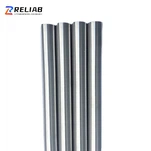
Many of the Titanium forgings are made by die forging technology. Titanium alloy die forging technology is widely applied in many high-end manufacturing fields such as aviation, aerospace, and medical care. The precise control of its process elements is crucial for obtaining high-quality titanium alloy forgings. The following will provide a detailed introduction to the key elements of titanium alloy die forging processes, including billet preparation, heating, lubrication, forging, cleaning, die design, and β forging of α+β two-phase titanium alloys.
1) Billet preparation
The surface quality of the billet directly affects the subsequent forging effect, so it must undergo rough machining or rough grinding treatment. For bars, turning or centerless grinding is usually adopted to ensure surface flatness and dimensional accuracy. In the billet cutting process, band saws should be given priority for operation, and the use of gas cutting for material cutting is strictly prohibited. Because the high temperature and oxidation effect generated by gas cutting may change the local chemical composition and microstructure of the billet, thereby affecting the quality of the forging.
2) Heating of billets
Before heating, the slag and oxide scale at the bottom of the furnace should be thoroughly removed to create a clean heating environment. The atmosphere in the furnace should be maintained in an oxidizing state, which can slow down the saturation process of hydrogen and reduce the adverse effects of hydrogen on titanium alloys. In order to reduce the oxidation degree of titanium alloys, prevent the invasion of hydrogen, avoid gas pollution and inhibit grain growth, it is necessary to strictly control the residence time of the billet at the heating temperature to ensure that the heating is completed only within the shortest time required to heat through the entire cross-section. Meanwhile, the mold needs to be preheated in advance. Generally, it should be kept at a temperature of 250 to 350℃ for more than 12 hours to ensure that the mold has good thermal stability and dimensional accuracy during the forging process.
3) Lubrication
It is crucial to lubricate the mold before forging. Lubrication can not only improve the defect of low fluidity of titanium alloys, but also effectively prevent forgings from sticking to the mold, thereby enhancing the surface quality of forgings and the service life of the mold. The commonly used lubricants are mixtures of gel-like graphite and water, or mixtures of graphite and MoS₂ (oil-based or water-based). These lubricants can form a uniform lubricating film between the mold and the billet, reducing frictional resistance and making the forging process smoother.
4) Forging
The deformation of die forging is generally controlled between 40% and 80%. After the last heating of the die forging, it is necessary to ensure that the entire metal undergoes uniform deformation. During the deformation process, the deformation temperatures of each part must be kept uniform to prevent the forging from cracking due to deformation at too low a temperature. Especially for α -phase titanium alloys, it is particularly important to provide sufficient deformation. Because the grain refinement of α -phase titanium alloys cannot be achieved through heat treatment methods, it can only be accomplished by deformation. A reasonable deformation amount can refine the grains and improve the mechanical properties of the forging.
5) Clean up
During the forging process of titanium alloy forgings, a brittle oxide layer will form on the surface. This oxide layer will cause the metal beneath the surface to crack during the next forging, seriously affecting the quality of the forging. Therefore, after each fire die forging, the oxide layer must be removed in a timely manner. Generally, the sandblasting method is adopted for cleaning. Sandblasting can effectively remove the oxide layer and impurities on the surface, restore the surface of the forging to smoothness, and prepare for subsequent processing.
6) Mold design
When designing molds for titanium alloy forgings, there is a difference in shrinkage rate between the molds for steel forgings, and the ratio of the two is 1:1.87. When using the same depth and complexity of the die chamber, the die for forging titanium alloy should be 50% thicker than that for forging steel, and a larger fillet radius should be adopted. This is because the fluidity and deformation characteristics of titanium alloys are different from those of steel. A larger fillet radius can reduce stress concentration during the forging process and lower the risk of cracking in forgings. Meanwhile, the surface finish of the die chamber is also required to be relatively high. A smooth die chamber surface can reduce friction and improve the surface quality and dimensional accuracy of the forgings.
7) β forging of α+β two-phase alloys
Forging in the entire β phase region can enhance the forging performance of titanium alloys at high temperatures or improve the notch toughness of forgings. In order to obtain forgings with high comprehensive performance, the microstructure of the alloy after β forging should be controlled to be within the range of 15% to 30% of the axial α phase in the transformed β phase. If there are too many equiaxed α phases, it will lead to a decrease in the notch toughness of the forging. If the equiaxed α phase is insufficient, the elongation will decrease. For forgings with excessive α phase, the notch toughness can be restored by heat treatment at a temperature below the β phase transformation (15 to 30℃) based on normal heat treatment practice.
All the links in the titanium alloy die forging process are closely connected and influence each other. Only by strictly following the process requirements can high-quality titanium alloy forgings that meet the demands of the high-end manufacturing field be produced.
Baoji Reliab Metal Materials Co.,Ltd
Tel: +86-917-8883215
Mobile: +8613092900605
+8613092913521
E-mail: garychen3215@hotmail.com